
Mars mineral bonanza?

If you could go to only one location on Mars, where would you find the most complete assortment of known Martian minerals? A new report, with lead author Patrick Thollot (Laboratoire de Planétologie et Géodynamique, CNRS), in the Journal of Geophysical Research provides an answer, but the information may not help mission planners much.
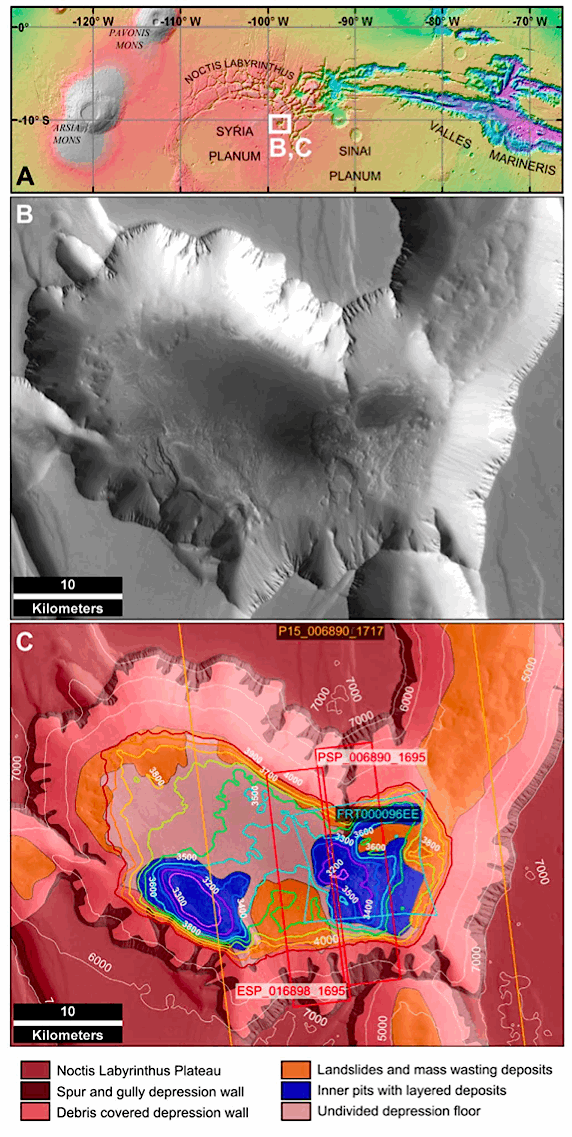
figure 1

MARS MINERAL BOWL. One canyon intersection in Noctis Labyrinthus displays a remarkable variety of minerals, the greatest yet found in any one place on Mars. (Image taken from Figure 1 in the paper.)

The place to find the “most Mars minerals in a nutshell” (quoting from the paper’s title) is the bottom of a canyon intersection in Noctis Labyrinthus, a large network of valleys, canyons, and depressions just west of Valles Marineris. Noctis likely formed around 3.8 billion years ago, perhaps when volcanic heat from nearby Tharsis melted subsurface ice, and the water escaping through fractures led the surface to collapse.

The floor of this particular depression stretches about 20 by 40 kilometers (12 by 24 miles), and contains a stack of minerals several hundred meters (roughly a thousand feet) thick.

But the canyon bottom lies some 3,500 meters (11,000 feet) below the level of the surrounding plain, and its upper walls have slopes steeper and rougher than current Mars rovers can traverse. And while its floor appears mostly flat, the depression makes a target too cramped (and probably too windy) for present landing technology.

The researchers used mainly data from the CRISM, HiRISE, and HRSC instruments. Their goal in studying the minerals was to use them as a way to unlock the location’s aqueous history, investigating how deposits of water-altered minerals formed there. As they explain, “This site shows local formation of almost all classes of minerals identified thus far on Mars.”

Minerals include iron-bearing silicates, sulfates, and oxides, plus numerous varieties of clays and hydrated salts. Opal and hydrated volcanic glass are also present, along with hydrated sulfates.

The team reports, “The mineralogical history of Mars that has been inferred recently envisions an early wetter environment on Mars, either warm or cold, with permanent or transient liquid water on the surface, that favored the formation of phyllosilicates [clays].”

Then, they explain, the environment shifted toward increasingly arid and acidic conditions, more favorable to the formation of sulfates. “At the end of this purported climate change (3.5 to 3 billion years ago), the Martian environment would have become extremely arid, cold, and oxidative, and has remained so until today.”

For the minerals in the nutshell, the researchers suggest a sequence of chemical alterations including “the formation of acid sulfate solutions from groundwater and magmatic sulfur, which then locally altered the basaltic bedrock and layered sediments mainly deposited from volcanic tephra, forming iron-smectite and iron-sulfates.”
Posted in Reports | Tagged , , , , , , , , , , , | 1 Comment

Latitude controlled Amazonian ice flows

Signs of underground ice deposited in the Amazonian period (the most recent in Martian history) are common in many places on Mars. Evidence includes tropical mountain glacier deposits, lobate debris aprons, lineated valley fill, concentric crater fill, and pedestal craters. In some locations, ice appears to have been more than a kilometer (3,300 feet) thick — and evidence from ground-penetrating radar suggests that ice is still preserved today as debris-covered glaciers.

map

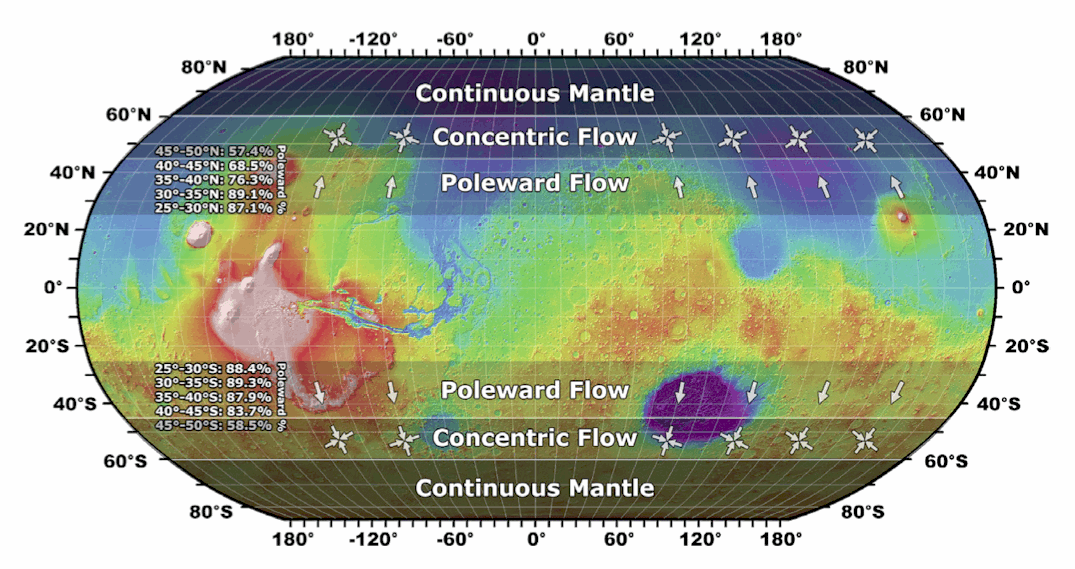
GOING WITH THE FLOW. The direction of flow for shallow subsurface ice falls into bands according to latitude. At latitudes higher than about 45°, the flow can go in any direction; below that latitude, flows occur just on pole-facing slopes. (Image taken from Figure 6 in the paper.)

A new study published by three Brown University planetary geologists argues that the orientation of ice flow features depends largely on the latitude of the location. Using the Context Camera (CTX) on the Mars Reconnaissance Orbiter, the scientists studied more than 10,000 images, and mapped flow features between 20° and 60° latitude in both northern and southern hemispheres of Mars.

Reporting in Icarus, the team led by James Dickson says that “poleward of about 40° to 45° in each hemisphere, ice accumulated regionally, regardless of slope orientation and specific microenvironments.” In these areas, where slopes were steep, the ice flowed downward; this flow produced concentric patterns seen today in the material filling the bottom of craters.

At latitudes closer to the equator than about 45°, they found that ice accumulated only on pole-facing slopes. In these locations, local microclimates became important, and flow features trend generally in a poleward direction. (And at latitudes lower than 25° there’s little or no evidence for flow because conditions were too warm for any ice to survive long enough to leave lasting geologic traces.)

Says the team, “These findings show that the most recent phase of significant ice-related flow on Mars is likely to have been focused in cold-traps on steep slopes in the mid-latitudes, and over all steep slopes at latitudes greater than 45° north and south.”

Posted in Reports | Tagged , , , , , , , | Comments Off

Did ice and dust make layered deposits in Valles Marineris?

Vast mounds of layered material lie in numerous places throughout the giant canyon system of Valles Marineris, and especially in Candor Chasma, Ophir Chasma, and Melas Chasma. The origin of these “interior layered deposits” (ILDs) have been debated since they were discovered in the early 1970s. Theories include lakebed deposits, sub-ice eruptions, and groundwater rising to alter beds of wind-blown volcanic ash and other materials.

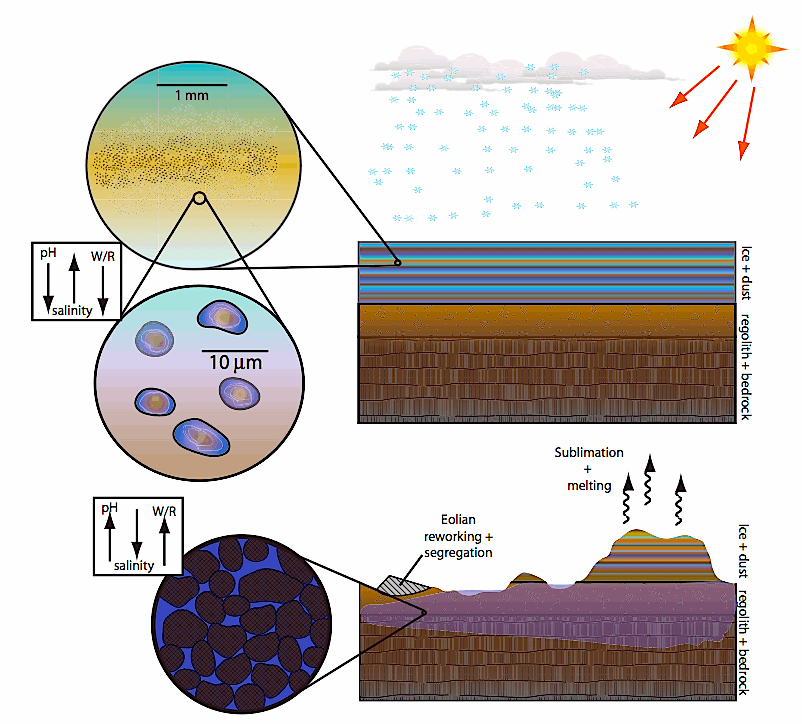
DUST AND ICE. A mixture of ice, dust, and sulfur-laden aerosols could have created layered deposits in Valles Marineris. As the ice in the deposits evaporated and sublimation, the dust would lose cohesion and erode. (Image taken from Figure 3 in the paper.)

Two scientists — Joseph Michalski (Planetary Science Institute) and Paul Niles (NASA Johnson Space Center) — now suggest in Geology that the ILDs formed by a climate-change driven process combining ice, dust, and volcano-generated sulfuric acid. (The two also recently advocated a related origin for the giant mound in Gale Crater.)

“We propose,” the scientists write, “that the ILDs are remnants of sediments originally composed of dust, ice, and acidic aerosols that were concentrated into discrete deposits at low latitudes during periods of high obliquity.” Models of the Martian climate over millions of years show that during such times when the rotation axis tilts more with respect to the Martian orbit, ice and snow accumulate in the equatorial regions instead of the poles.

The researchers continue, “Recent spectroscopic results show that these materials contain coarse-grained hematite, sulfates, and clays. These suggest that the layered deposits are fundamentally similar to layered sulfate deposits seen elsewhere on Mars, and are therefore a key piece of the global aqueous history of Mars.”

A problem with previous explanations for making the ILDs through groundwater or lakebed deposits is that these theories require unrealistically large quantities of material to be deposited and eroded.

The atmospheric deposition model avoids these requirements, they note. “Many of the complications of explaining the ILDs as sourced from groundwater or standing bodies of water are nonfactors if the sediments originated through atmospheric sources.

“We favor an alternative model in which the ILDs form in a configuration similar to what is observed today through atmospherically driven deposition of ice, dust, and volcanogenic sulfuric acid.”

Posted in Reports | Tagged , , , , , , , , , , , | Comments Off

Mars dunes move as much as Earth dunes

Scientists have known for years that Martian sand dunes and ripples move as wind blows over them. But for the most part they thought the motion was small because the atmosphere is thin and high-speed winds are rare.

CREEPING SANDS. HiRISE images from 2007 and 2010 let scientists measure the motion of sand ripples and dunes in Nili Patera. The results indicate that for Nili at least, the sand movements are comparable to dune movements on Earth. The wind-rose at upper right shows prevailing winds blow from the northeast, driving the dunes to the southwest. (Image taken from Figure 1 in the paper.)

Now new research using before-and-after images taken by the HiRISE camera on NASA’s Mars Reconnaissance Orbiter shows that the amount of sand movement in one place at least is comparable to what’s seen on Earth. These reveal that entire dunes as much as 60 meters (200 feet) thick have moved as a unit.

After studying the dune field in Nili Patera, Nathan Bridges (Johns Hopkins University Applied Physics Laboratory) and colleagues write in Nature that, “The dunes are near steady state, with their entire volumes composed of mobile sand.” The images were taken in 2007 and 2010.

“We chose Nili Patera because we knew there was sand motion going on there, and we could quantify it,” says Bridges. “The Nili dunes also are similar to dunes in places like Antarctica and to other locations on Mars.”

The movement of sand ripples amounted to as much as 4.5 meters (about 15 feet). The scientists also noted that ripples moved faster as they rose up the wind-facing side of the dunes. By correlating ripples’ movement to their position on the dune, the analysis determined the entire dunes are moving. This let the scientists estimate the volume, or flux, of moving sand.

How much did they move? The team calculates that if you stood in the Nili Patera dunes and measured across a one-yard width, you would see more than two cubic yards of sand, about as much as in a child’s sandbox, pass by during an Earth year.

This conflicts with previous views, says the team. “One view of Mars has been that conditions since the end of the Hesperian period, 1.8 billion years ago, have been fairly static, with very low erosion rates. This study shows that this is not the case at Nili Patera, and probably not at other areas of Mars where there are significant gusts of sand and wind.”

Yet the new results help explain a geological puzzle, they say. “Vast areas of the Martian surface show evidence of erosion and removal, including of mantle materials for which the processes and agents of exhumation have been a mystery — yet these places also contain fields of large dunes that migrate at relatively slow rates.

“Over long time periods, it may be that much or all of Mars has been subjected to large sand fluxes, with associated erosional modification of the landscape.”

Says Bridges, “No one had estimates of this flux before. We had seen with HiRISE that there was dune motion, but it was an open question how much sand could be moving. Now we can answer that.”

Posted in Reports | Tagged , , , , , | Comments Off

Mars Rover Opportunity explores Cape York

Mars Exploration Rover Opportunity reached the south end of Cape York, a segment of the rim of Endeavour Crater about 700 meters (2,300 feet) long, on August 9, 2011. Scientists and engineers examined several targets there before driving the rover to an over-wintering site at the north end of the rim segment. Opportunity has been spending the Martian winter at Greeley Haven.

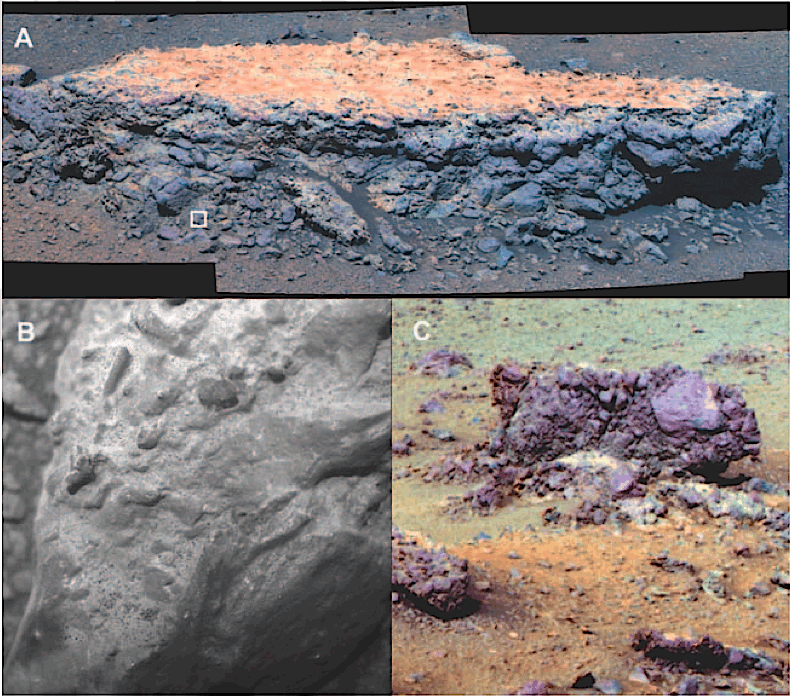
TISDALE. A false-color Pancam image shows Tisdale, a foot-high block of ejecta from the small crater Odyssey. A close-up view (B) shows it's made of rocky fragments of all sizes welded together by impact melt. This probably indicates an origin in the impact that formed Endeavour Crater. Image C shows yard-wide Kidd Creek, another block of breccia. (Image taken from Figure 3 in the paper.)

Endeavour Crater spans 22 kilometers (14 miles) rim to rim and dates to the Noachian Era, the oldest period in Martian geologic history, more than 3.7 billion years ago. Project scientists led by Steven Squyres (Cornell University) have now published (May 3, 2012) a report in Science which gives details about the rocks of the Shoemaker Formation, which make up Cape York.

This formation is an impact-shattered rock unit (dubbed a breccia), which is a common feature at impact craters. The breccia is made of fragments (called clasts) of the target rock, the ancient basalts of Meridiani Planum, mixed with impact-melted rock.

As noted back in December, the geological story of Cape York combines rocks, impact energy, and groundwater. Scientists identified several rocks and outcrops that embodied parts of the story. The new report extends the findings.

“We suggest that Tisdale [a foot-high rock] may represent the main breccia unit of the rim,” the team writes. “And Chester Lake [a yard-wide rock] and the rocks near Greeley Haven were emplaced later in the impact flow.”

Making a gently sloping bench all around Cape York are sandstones that belong to the same flat-lying sedimentary rocks that Opportunity landed on in January 2004 — and on which it spent its entire mission up until it arrived at Cape York. Cutting into this bench are several thin bright veins. Opportunity studied one of these veins, dubbed Homestake,  and found it was almost pure gypsum.

The scientists say, “The gypsum veins at Cape York provide clear evidence for relatively dilute water at moderate temperature, perhaps supporting locally and transiently habitable environments.

“More broadly,” they continue, “rocks at Cape York appear to record early events in a transition from (commonly) hydrothermal waters that altered basaltic crust to phyllosilicates to sulfate-charged ground waters that generated salt-rich sandstones deposited widely over the Meridiani plains and elsewhere.”

Summing up, the team says, “The ubiquity of impact breccia at Cape York contrasts with the only other Noachian terrain explored in situ, the Columbia Hills in Gusev Crater. The rover Spirit encountered great lithologic diversity there, including materials interpreted as impact ejecta. However, none were breccias, and none had the lateral extent of the Shoemaker formation.

“We suggest that the difference can be attributed to Opportunity’s sampling of the rim deposits of a single large crater, rather than Spirit’s sampling of more distal ejecta from multiple impacts.”

Posted in Reports | Tagged , , , , , , , , , , , , | 1 Comment

Lava coils: new form of flow discovered on Mars

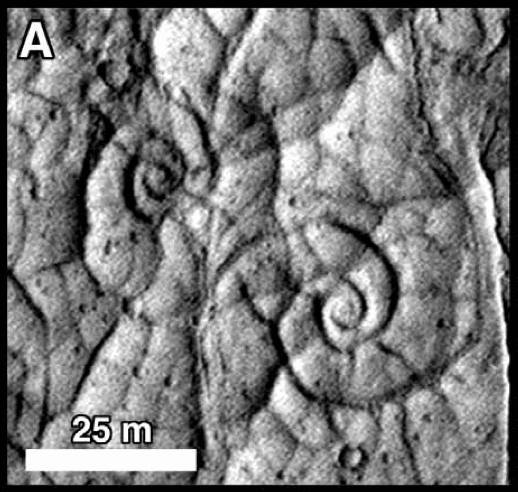
High-resolution photos of Martian lava flows show coiling spiral patterns that resemble snail or nautilus shells. Such patterns have been found in a few locations on Earth, but never before on Mars. The discovery appears in a paper in Science published by Andrew Ryan and Philip Christensen (both Arizona State University).

CURLICUES OF ROCK. Never before seen on Mars, lava coils can occur when lava flows are pulled in two directions at once while the lava is still soft and plastic. The scale bar is 82 feet long. (Image taken from Figure 2 in the paper.)

The new result came out of research into possible interactions of lava flows and floods of water in the Elysium volcanic province of Mars.

“Athabasca Valles has an extensive literature,” Ryan says,  “as well as an intriguing combination of seemingly fluvial and volcanic features.” Among the features are large slabs or plates that resemble broken floes of pack ice in the Arctic Ocean on Earth. In the past, a few scientists have argued that the plates in Elysium are in fact underlain by water ice.

Assessing claims that ice was present today beneath the lava plates drove Ryan to study the area. This led him to look closely at every available image of the region, with an emphasis on those from the HiRISE camera on Mars Reconnaissance Orbiter.

“I first noticed puzzling spiral patterns in an image near the southern margin of Cerberus Palus,” Ryan explains. “The coils become noticeable in the full-resolution HiRISE image only when you really zoom in. They also tend to blend in with the rest of the light-gray terrain until you stretch the contrast a bit.”

On Earth, lava coils can be found on the Big Island of Hawaii, mainly on the surface of ropey pahoehoe lava flows. They have also been seen in submarine lava flows near the Galapagos Rift on the Pacific Ocean floor.

As Ryan explains, “The coils form on flows where there’s a shear stress — where flows move past each other at different speeds or in different directions. Pieces of rubbery and plastic lava crust can either be peeled away and physically coiled up — or wrinkles in the lava’s thin crust can be twisted around.”

Similarly, he notes, scientists have documented the formation of rotated pieces of oceanic crust at mid-ocean ridge spreading centers. “Since the surface of active lava lakes, such as those on Hawaii, can have crustal activity like spreading centers do, it’s conceivable that lava coils may form there in a similar way, but at a smaller scale.”

The size of Martian lava coils came as a surprise. “On Mars the largest lava coil is 30 meters across — that’s 100 feet. That’s bigger than any known lava coils on Earth,” he says. Ryan and Christensen’s work has inventoried nearly 200 lava coils in the Cerberus Palus region alone.

Looking ahead, Ryan says, “Lava coils may be present in other Martian volcanic provinces or in outflow channels mantled by volcanic features. I expect that we’ll find quite a few more in Elysium as the HiRISE image coverage grows over time.”

Posted in Reports | Tagged , , , , , , | 1 Comment

Sea cliffs in Libya Montes?

New work suggests that three possible shorelines from ancient lakes or seas in Isidis Planitia lie in Libya Montes.

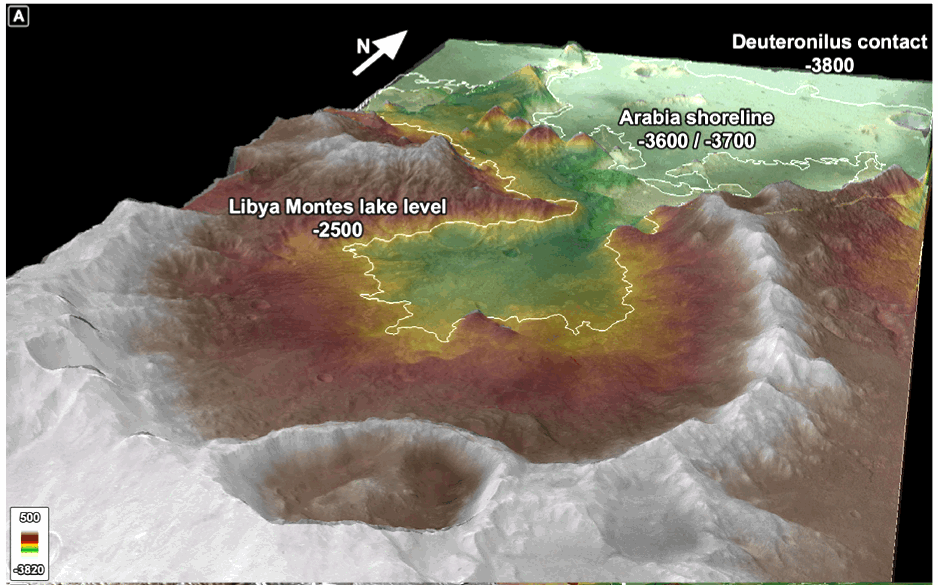
SHORELINES? Distinct levels which may represent ancient shorelines appear in central Libya Montes. Possible coastal cliffs appear at –3600 and –3700 meters, indicating two distinct surface levels for bodies of water. Elevations are in meters relative to the mean radius of Mars. (Image taken from Figure 4 in the paper.)

These mountains form the southern rim of Isidis, a Noachian-age impact basin 1,225 kilometers (760 miles) in diameter. They lie along the highland/lowland boundary and consist mainly of mountainous massifs and ridges, mixed with remnants of impact craters. In numerous places the montes show evidence of flowing water: fluvial channels, deltas, and alluvial fan deposits.

Now a team of scientists led by Gino Erkeling (University of Münster) is proposing that they have identified old shorelines or sea cliffs in Libya Montes. If true, these strengthen the case for possible sea-scale standing bodies of water in the Isidis basin and other depressions on Mars in the past. The new work appears in a recent paper in Icarus.

“At the Libya Montes/Isidis Planitia boundary, we identified landforms at three different elevation levels,” says the team. “The landscape features show evidence of intense fluvial activity, standing bodies of water, alteration by water, wave-cut action, and distinct water levels caused by freezing and sublimation of a cold ocean.”

In an unnamed crater 60 kilometers (45 miles) wide, the team found the first features at elevations between –2500 and –2800 meters relative to the Martian datum. They include valleys, terraces, delta deposits with hydrated minerals, and an outlet in the crater rim. These all point to a standing body of water in the crater, say the scientists.

About one kilometer (3,300 ft) lower lie shoreline features consisting of cliffs and terraces. The researchers write, “Most conspicuous are a series of candidate coastal cliffs of the Arabia shoreline that coincide with the –3700 meter elevation.” The cliff landforms possibly resemble terrestrial sea cliffs eroded by wave-cut action and could have formed during sea-level variations of an Isidis sea.

The lowest feature the scientists identify is the –3800 meter Deuteronilus contact. It is likely the result of standing water — or an ice sheet — that filled the northern lowlands of Mars.

The landscape features are consistent, the team says, with a global change in climate from warm and wet conditions to cold and dry ones.

“Because the possible shorelines appear close to each other in the Libya Montes,” they say, “we propose this site as a new candidate landing site for potential future missions after MSL Curiosity.”

Posted in Reports | Tagged , , , | Comments Off

Big pile in Gale Crater

Gale Crater, the landing site for NASA’s Mars Science Laboratory rover (named Curiosity), contains a 5-kilometer (3-mile) high stack of sediments that was the reason for sending the the rover there.

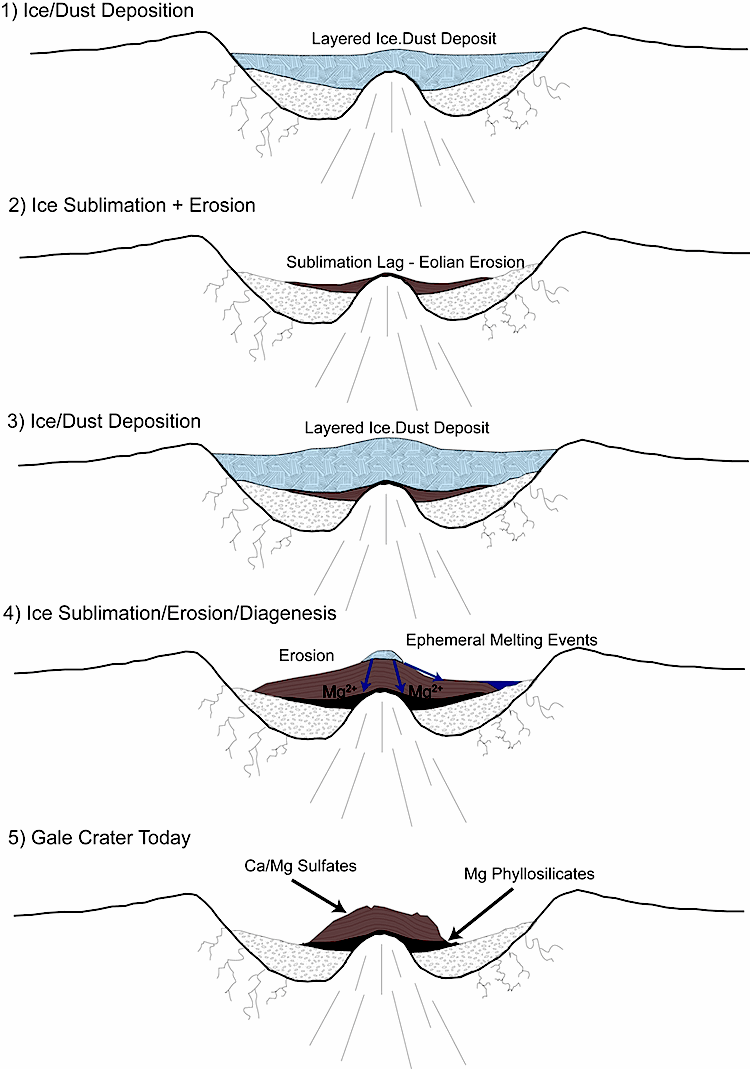
DIRTY SNOWFALLS. Repeated deposits of dust mixed with ice or snow could have built up the giant mound in Gale Crater (and other craters with similar mounds). The process resembles that which scientists think constructed the Martian polar caps. (Image is figure 2 from the paper.)

How did the giant mound form?

Dirty snow and ice, say Paul Niles (NASA Johnson Space Center) and Joseph Michalski (Planetary Science Insitute, UK). Presenting their research (PDF) at the 43rd Lunar and Planetary Science Conference in The Woodlands, Texas, the scientists argue that the mound is the residue of countless layers of snow, ice, and sediments deposited in Gale by repeated climate cyles.

In essence, they say, the Gale Crater mound is similar in type and origin to the layered deposits found in both Martian polar caps.

As they reconstruct Gale’s history, they say the crater formed about 3.55 billion years ago. Some time afterward, it was filled with dust, ice, and sulfur-rich aerosol particles. This process, interrupted by episodes of erosion, occurred repeatedly as the Mars’ rotation axis cycled through many changes in inclination. These drove changes in climate operating over millions of years.

Sediments, especially the older ones lower in the mound, were recycled and reworked. Deposits of snow and ice within the mound evaporated into the atmosphere, letting the dusty layers settle and become more compact. Some ice likely remains in the mound today. As the stack grew, trapped ice and water combined with the minerals in the dust to form sulfates and clays, as seen today.

From time to time, wind erosion removed parts of the mound, then new deposits arrived, draping over older ones to leave sloping and intersecting layers.

“Curiosity will make several observations to test this hypothesis,” the researchers say. “Similar to Meridiani Planum, the sediments should be fine-grained with chemical compositions that closely resemble martian dust.” In addition, they do not expect Curiosity to find beds of pure carbonates, sulfates, or other salts which would point to a standing lake or other body of water in Gale.

But they do expect to see “abundant unconformities, which suggest many multiple cycles of deposition and erosion.”

The scientists of the Mars Science Laboratory mission have informally named the Gale Crater mound as Mount Sharp. The name commemorates Caltech geologist Robert P. Sharp (1911-2004), a founder of planetary science, influential teacher of many current leaders in the field, and team member for NASA’s first few Mars missions.

Posted in Reports | Tagged , , , , , , , , | Comments Off

Hidden valley at the north pole

The north polar cap of Mars has a wide, deep trough called Chasma Boreale that slices into the polar cap for 560 kilometers (350 miles).

HIDDEN VALLEY. Radar profiles from the MARSIS instrument have uncovered a large trough (yellow arrow) in the Basal Unit that lies beneath the north polar ice cap. (The red area at left shows where the Basal Unit is thickest.) Image is from Figure 2 in the paper.

The floor of the chasma exposes a layer of sand and dust cemented with water ice. This layer, known to scientists as the Basal Unit, underlies the entire ice cap and rests upon the bedrock of the northern plains.

New, high-quality data from the MARSIS radar sounding instrument on the Mars Express orbiter has let scientists explore the shape and internal structure of the Basal Unit. The data have revealed another trough nearly as large as Chasma Boreale. However this new valley, which measures about 400 km long by 100 km wide (250 by 60 mi), lies entirely within the Basal Unit itself and is hidden from view, being covered by the polar ice deposits.

At the 43rd Lunar and Planetary Science Conference in The Woodlands, Texas, a team of MARSIS scientists led by Alessandro Frigeri (Istituto di Astrofisica e Planetologia Spaziali of INAF, Italy) presented a 3D computer reconstruction of the Basal Unit. The reconstruction revealed internal layering of the Basal Unit and the new trough.

The team built the computer model using about 160 MARSIS sounding radar profiles across the whole polar region. The profiles were extracted from those made between May and December 2011, under conditions that produced data of unprecedently high quality.

The researchers started by making a 3D computer model of the entire polar cap, including the Basal Unit. This let them explore reflections from within the Basal Unit and from its contacts with the Northern Plains and the upper, more icy, polar cap deposits. Then they linked up radar reflections within the ice that come from the unseen top of the Basal Unit to draw a picture of the unit’s upper surface as well as its bottom layer.

“The result of this analysis,” says Frigeri, “are three-dimensional maps of the echoes from the Basal Unit that are starting to reveal its internal structure as well as its overall morphology.”

The modeling was complicated by the fact that the researchers had to assume an average value for the radar transparency of the ice cap and Basal Unit. In reality, the transparency likely varies both from place to place and from layer to layer.

The team plans to improve the model by using more realistic figures for radar propagation speeds. They will also integrate the work of colleagues who are analyzing the same area using data from MARSIS’ companion radar instrument, SHARAD, which is on board the Mars Reconnaissance Orbiter.

Posted in Reports | Tagged , , , , , , , , | Comments Off

How old is Meridiani Planum?

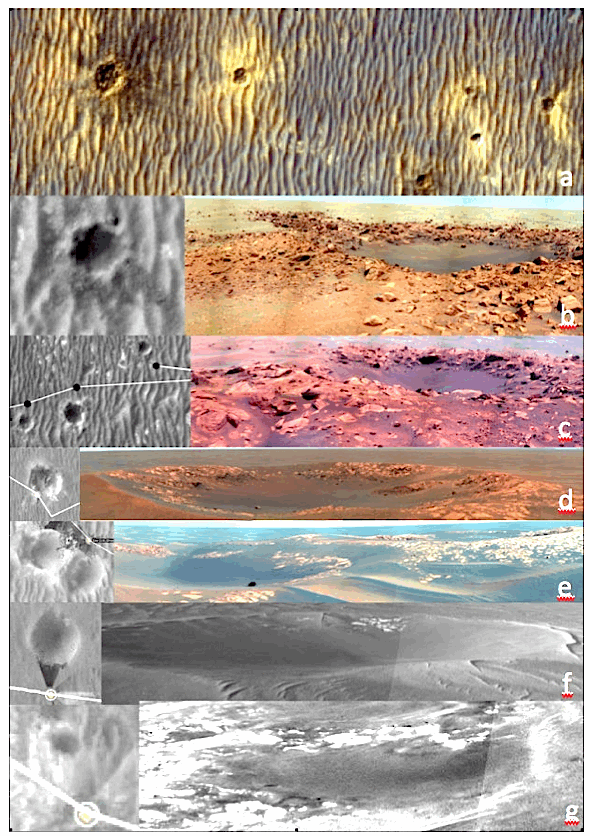
CRATER REMOVAL SERVICE. Opportunity's long drive has taken it past craters of many different ages. These range from ones less than 10 years old (a) to those that are roughly 10 milllion years old (g). (Image is Figure 1 from the paper.)

The smooth, flat plain where Mars rover Opportunity landed in January 2004 looks spookily empty. Only a few rocks and meteorites, plus foot-high sand dunes and ripples, break the endless vista under a clear tawny sky.

How long has the scene looked like this? Or to put the question another way, how old is this surface?

About 10 million years, says Matt Golombek (Jet Propulsion Laboratory), reporting (PDF) at the 43rd Lunar and Planetary Science Conference in The Woodlands, Texas. “That’s the crater retention age.”

He points out that’s not the whole picture, however. “Crater counts of Meridiani Planum show a surface with two ages. Craters larger than about 2 kilometers [6,600 feet] in diameter are highly degraded with light-toned rims. These are Noachian in age, or more than 3.7 billion years old.”

That’s the approximate age of the light-colored sulfate-rich sandstones that Opportunity drove across between its landing and its current operations at Cape York. The latter is a heavily eroded rim segment of Endeavour Crater, and its rocks are even older than the Meridiani sandstones.

But Golombek says craters smaller than about 100 m (330 ft) in diameter are much, much younger: only about 10 million years old. As he describes it, “Fresh craters have sharp, blocky rims with clearly defined blocky ejecta blankets and rays. With time, these soft sulfate rocks are planed off parallel to the surface by saltating sand grains, and crater interiors are filled with sand.”

What’s left in the end, he explains, “is a flat crater rim surrounding a subtle, broad topographic depression.”

Golombek explains that erosion operates relatively quickly at first because the crater’s features stand out above the plain. But the removal rate then becomes more and more gradual as crater features erode, its profile lowers, and sand fills it in.

Opportunity has driven 34 kilometers (21 miles) across the Meridiani plains since landing. “Craters in all stages of degradation have been visited by the Opportunity rover and imaged by HiRISE from orbit,” Golombek says.

As a result, he notes, “We understand how large and deep a crater of a given diameter is when fresh. And when we compare that with what Opportunity sees, we can estimate how old the crater is.”

Posted in Reports | Tagged , , , , , , , | Comments Off