


Slope streaks not becoming more common; survive for decades

Slope streaks are dark lines that run down dusty slopes on Mars; scientists explain them as dust avalanches touched off by rockfalls or some similar trigger. (Slope streaks differ in nature and cause from a different kind of streak, dubbed “recurring slope lineae,” which are also dark but are probably caused by seeps of liquid brine.)
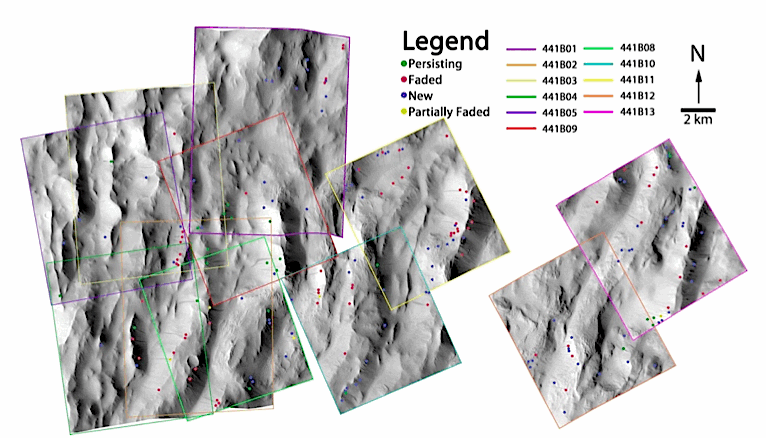
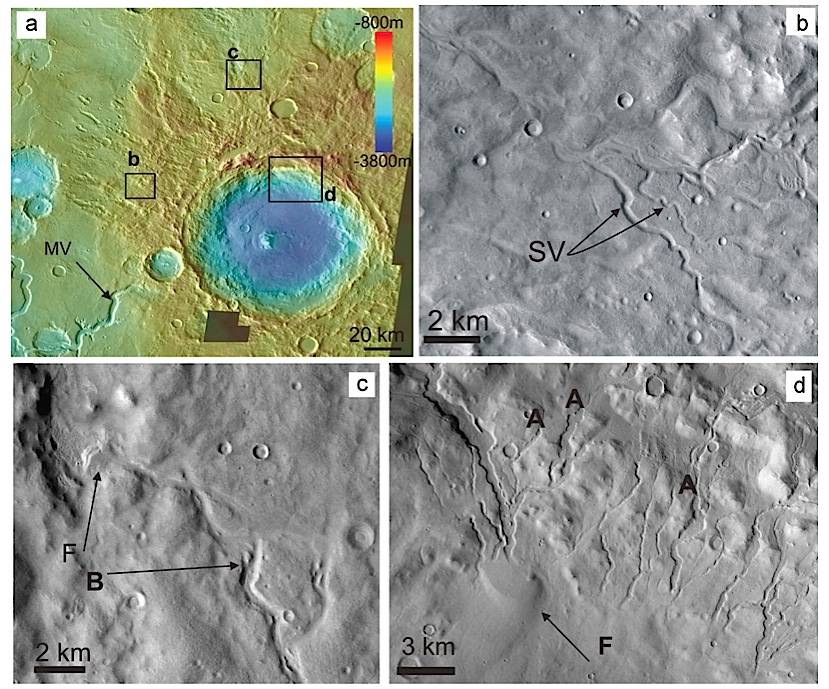
GOING.…GOING… Lycus Sulci offers an abundance of slope streaks whose varying ages helped determine the average streak has a lifetime measured in a few decades. (Image is Figure 1 from the paper.)

A new study of slope streaks, led by Norbert Schorghofer (University of Hawaii), combined 30- to 33-year-old Viking Orbiter images with more recent ones (2007-2010) taken by the Context Camera (CTX) on the Mars Reconnaissance Orbiter. The scientists found that slope streaks are in a more or less steady-state and have an average lifetime estimated to be around four decades.

The report (PDF) was given at the 43rd Lunar and Planetary Science Conference in The Woodlands, Texas.

Earlier work by others had suggested that slope streaks were forming more rapidly in recent years, thus becoming more common. However, the Schorghofer team found that when they examined the Viking record more carefully, the surge of streaks over recent years proved an illusion caused by the higher resolution of newer images. When CTX and Viking images of the same areas were compared at similar resolution, the effect went away.

Still, puzzles remain. Interestingly, the researchers found that the big global dust storm of 2001 did not erase the population of slope streaks. In addition, in their Lycus Sulci study area, the team found “islands of persistence” — locations where for some reason streaks lingered longer than elsewhere.

And finally the team noted, “On the smaller scale of individual streaks, we identified no common pattern for partially faded streaks. They fade from the head or the tail or from the outside toward the interior.”

Posted in Reports | Tagged , , , , | Comments Off

Seasonal changes seen in south polar gullies

Images from the HiRISE camera on NASA’s Mars Reconnaissance Orbiter have captured the first visible evidence for seasonal changes in gullies on slopes in the south polar region of Mars.

CHANGES over two Mars years (MY 29 and 30) as dark material travels down a high-latitude southern gully. Mars year 29 began December 2007, Mars year 30 began October 2009. Martian seasons are denoted by the Sun's longitude (LS), with southern spring beginning at LS = 180. (Image taken from Figure 1 in the paper.)

Giving a report (PDF) at the 43rd Lunar and Planetary Science Conference in The Woodlands, Texas, a team of scientists led by Jan Raack (Westfälische Wilhelms-Universität, Germany) says they spotted seasonal activity in gullies within the last two Martian years on slopes of a polar pit. The pit is about 1,000 meters (3,200 feet) deep and lies in a filled crater about 54 km (33 miles) wide, lying north of Sisyphi Cavi at 68.5° south and 1.5° east.

The team suggests that the source material of the gullies appears to be relatively fine grained sediments mixed with boulders about 5 m (17 ft) in diameter. Seasonal activity has been seen before in the polar regions, they note, adding that their research focuses on the exact timing for changes in gullies, and on the possible medium and mechanism driving gully activity.

The HiRISE images showed new small deposits appearing on the gully apron and dark material travelling down gully channels, although the team saw no erosion in the gully alcoves or channels.

Carbon dioxide ice lingered in the region into local spring, then disappeared as temperatures rose from about –93° C (–135° F) to –33° (–27° F), causing the CO2 ice to sublimate into the atmosphere. After the CO2 ice was gone the changes stopped.  This led the researchers to conclude, “Sublimating of CO2 is the most likely candidate to initiate these changes, but involvement of small amounts of H2O brines can not be ruled out.”

Posted in Reports | Tagged , , , , | Comments Off

Pitted deposits in Mars craters point to subsurface ice

Studies of pitted deposits in crater floors appear to indicate that subsurface ice has been more widespread on Mars than previously thought. That’s the conclusion of a team of reseachers led by Livio Tornabene (University of Western Ontario), who reported (PDF) on the finding at the 43rd Lunar and Planetary Science Conference in The Woodlands, Texas.

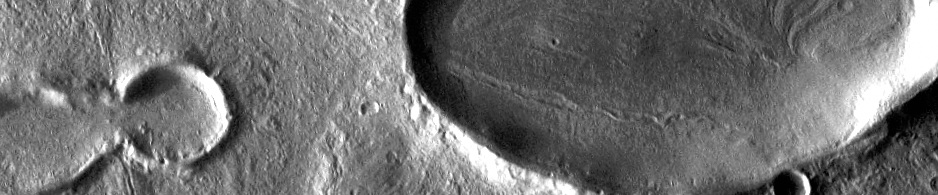
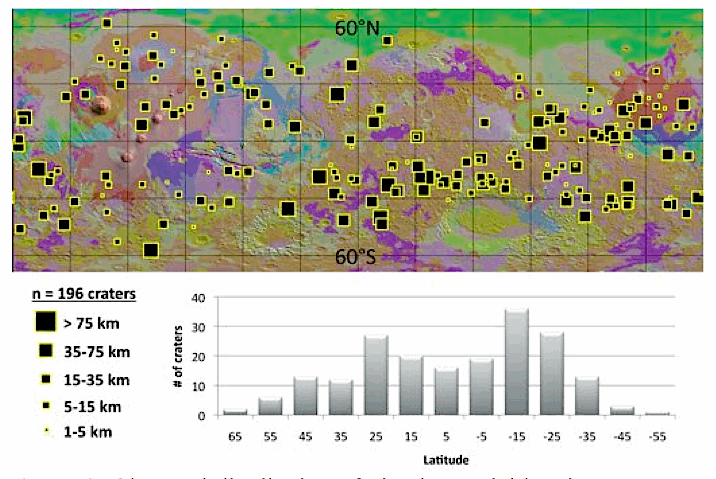
CRATERS WITH PITTED deposits lie in many areas of Mars, according to a new study, but only where water or ice likely existed formerly. (Image taken from Figure 2 in the paper.)

The team did a global survey using HiRISE and CTX cameras on NASA’s Mars Reconnaissance Orbiter of fresh craters and found more than 200 between 60° north and south latitudes that show pits on their floor materials. A great many Martian craters have deposits on their floors that are most likely pools and sheets of melted rock, liquified by the heat of impact, but only the 200 or so show pit features.

The craters with pits on their floors range in diameter from 1 to 150 kilometers. About 75% of the pitted craters lie between 10° and 30° north and south of the equator, latitude bands where subsurface water and ice were left by changes in the Martian climate.

Impact melt pools also form in lunar craters, says the Tornabene team. But when one examines Moon craters at high-resolution, pits like the Martian ones are not found anywhere. “The lack of observable pits in meter-scale images of fresh lunar craters suggests that the Martian pits could be due to volatile interactions with impactites generated during the impact process.”

As a possible parallel with the Moon, they point to a fresh crater (dubbed Pangboche) which they found near the summit of Olympus Mons. It shows a pool of impact melt but no pitting because environmental conditions at the volcano’s summit have long been Moon-like, with extremely low air pressure and a short lifetime for subsurface ices.

The researchers explain, “We suggest that the pits form from the interaction between hot impact-melt bearing breccias and entrained water derived from the target materials. Volatilization of water within the deposit leads to rapid, and perhaps explosive, degassing of the deposit, with pits corresponding to locations of degassing pipes.”

Posted in Reports | Tagged , , , , , , | Comments Off

Southern polar eskers point to warmer past

Ice caps and glaciers on Mars today are “cold based,” meaning they are frozen solid to the ground beneath them. Scientists think the ice has been this way for most of the Amazonian period, the latest chapter in Mars’ geological history. It began roughly 3 billion years ago and continues today.

MEANDERING RIDGES in Dorsa Argentea trace the paths of streams that flowed under an ancient south polar ice sheet larger than the current one. (Image taken from Figure 1b in the paper.)

However, beyond the edge of the current south polar ice cap lies the Dorsa Argentea formation, which shows evidence for eskers. Well-known from terrestrial examples, eskers are low ridges made by streams that flow under glaciers, leaving deposits of rocks, gravel, and sand along their courses. When the ice disappears, the stream sediments are left standing above the surface as meandering ridges.

Dorsa Argentea’s eskers point up two facts: the polar cap was once more extensive, and the bottom of that ancient ice cap was warm enough for sub-glacial streams to flow.

These facts can provide clues to ancient climate, says a group of researchers led by glaciologist James Fastook (University of Maine). Writing in Icarus, the scientists noted that eskers require liquid water beneath the ice. Then they asked how much warmer the atmosphere needed to be to melt the base of ice cap. And similarly, how would the ice cap respond to the likely geothermal heat flow earlier in Martian history?

The team used two computer models, one for the atmosphere and climate, the other for the ice cap’s behavior. (They also assumed the ancient ice cap had a larger footprint to include Dorsa Argentea.)

The ice model showed that the geothermal heat flow back in Noachian and Hesperian times (from more than 4 billion years ago until about 3 billion years ago) was not high enough to melt the base of the ice cap. Thus the team’s “bottom up” hypothesis was unable to produce eskers.

But the atmospheric (“top down”) model produced a different result. Even when average temperatures remained well below freezing, the model showed the ice cap would seasonally produce small amounts of meltwater at the bottom of the ice cap. There it would accumulate until eventually it tunneled out, producing eskers.

The team says, “In order to produce significant basal melting at these typical geothermal heat fluxes, the mean annual south polar atmospheric temperatures must be raised from today’s -100° C [-148° F] to the range of -50° C to -75 °C [-58° F to -103° F].”

Looking more widely across Mars, they add that the warmer temperatures at the southern ice cap did not translate into a generally “warm and wet” early Mars for latitudes closer to the equator. While some melting would have occurred there, overall “the late Noachian climate of Mars may have been similar to the current hypothermal, hyperarid climate of the Antarctic Dry Valleys on Earth.”

In Antarctica, the team notes, “Seasonal melting leads to the formation of transient streams and ice-covered lakes that have similarities to the valley networks and open basin lakes on Mars.”

Posted in Reports | Tagged , , , , , | Comments Off

Radiation risks on manned Mars missions

The basic plan for an initial manned mission to Mars, including a landing, calls for a flight lasting about 430 days. While the mission would involve obvious dangers, among these — but often overlooked — are the risks posed by energetic natural radiation.

RUNNING INTERFERENCE. An astronaut standing on the surface of Mars would be exposed to only half the galactic high energy radiation, thanks the blocking effect of the planet. Even the atmosphere helps shield a little. (NASA image)

According to a team of researchers led by Susan McKenna-Lawlor (Space Technology Ireland), these risks are significant. Writing in the journal Planetary and Space Science, they say that although there are ways to mitigate the risks, “the health problem posed by energetic particle radiation [for a human trip to Mars] is presently unresolved.”

Tallying the sources of natural particle radiation faced by a Mars-bound crew, the scientists list passing twice through Earth’s Van Allen radiation belts, cosmic rays from sources in the Milky Way Galaxy, and events such as flares where the Sun emits blasts of energetic particles.

The researchers considered three strawman flight plans developed by NASA: a Mars swingby flight with no landing, a flight with a surface stay of 30 days, and a long-stay version that spends 600 days (most of one Mars year) on the surface. These flights had durations lasting 600 days, 430 days, and 1,000 days, respectively. (The flight plan, celestial mechanics, and the orbits of Earth and Mars govern the durations.)

In regard to the Van Allen belts, experience from Apollos 8 and 10 through 17, which transited them going to and coming from the Moon, shows that they pose little difficulty.

The cruise to Mars and the stay on the surface last much longer, however, and both expose the crew to energetic particles from galactic cosmic rays and from the Sun. These are not negligible, according to the team.

Cosmic rays are the nuclei of chemical elements accelerated to very high energies outside the solar system. At solar maximum more solar particles and interplanetary magnetic fields interact with incoming cosmic rays and remove lower energy particles. This operates conversely as well — the most recent solar minimum produced, in 2009, the highest cosmic ray dose in the last 25 years.

Unlike solar activity cycles, however, solar flares occur unpredictably, though they are more common, stronger, and thus more dangerous around the high points of each cycle. Yet the researchers note that it can’t be assumed these particle events will not occur at solar minimum also.

One saving grace: the rocky bulk of Mars shields a person standing on the surface from half the radiation that would strike that person while in transit to or from Earth.

So how much radiation would be likely? The team says, “The dose incurred during a 400-day Cruise Phase due to galactic cosmic radiation is estimated to be hazardous.” They add that the amount would approach the radiation dose that NASA allows space personnel to accumulate over an entire career.

Choosing the low spots in a solar cycle offers no guarantees, either: “It cannot be excluded, whether a manned mission takes place under solar minimum or solar maximum conditions, that a particle associated flare…might take place during the transit to/from Mars.” Such events at present are simply unpredictable.

Finally, the scientists say, “The occurrence during the mission Cruise Phase of a major solar energetic particle event characterized by [high energies] could deliver a lethal dose of radiation.”

Posted in Reports | Tagged , , , , | Comments Off

Ancient volcanos suggest long activity

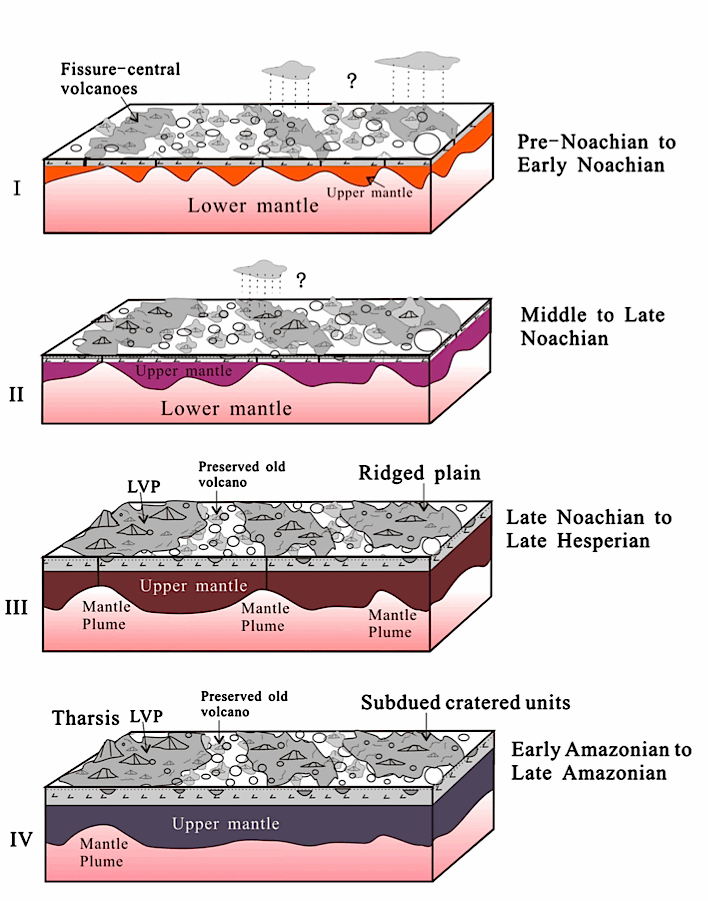
Mars is a volcanic planet and has been volcanically active from the start. The most extensive volcanism occurred during the earliest part of its geologic history, the Noachian era, the time before roughly 3.7 billion years ago.

VOLCANIC ACTIVITY EVOLVED from mainly plains volcanism in stage I to regional activity (II) to big volcano building from volcanic plumes (III) to finally recent small shield volcanos and plains volcanism again (IV). (Image is Figure 6 from the paper.)

However, as a group of Mars geologists led by Long Xiao (China University of Geosciences) write in Earth and Planetary Science Letters, “long-term and significant geologic modification, heavy degradation, and resurfacing processes complicate the identification and characterization of the volcanos produced in the Noachian.”

The scientists used imaging data from THEMIS, HRSC, and CTX cameras to identify and study 75 early Noachian volcanos in the southern highlands. The regions studied are mostly south of Tharsis and in the circum-Hellas volcanic region.

Although these areas are heavily cratered, the volcanos lie in areas mapped previously as hilly features — mesas, knobs, and broad areas that rise above the local terrain. According to the scientists, recent and more complete imagery reveals these features are chiefly isolated structures and thus not caused by tectonic activity or impacts.

Many of the volcanos showed signs such as radial channels that suggest either fluvial or lava erosion, the scientists noted. They found that Noachian volcanos “occur as shields and lava plains and have mostly been modified by impact craters and channels, while Hesperian [i.e., younger] volcanism is primarily flood lavas and a number of low shield volcanos.”

Putting together the overall picture, the team suggests that these Noachian volcanos are the oldest surviving ones on Mars (and perhaps in the solar system). They also argue that, “Most of these features are adjacent to or partially overlap the Tharsis Province and the circum-Hellas Volcanic Province.” This suggests, the team says, that “these ancient volcanos are part of these two large volcanic provinces, possibly indicating that the volcanic histories of these provinces was longer than previously thought.”

Posted in Reports | Tagged , , , | Comments Off

Watch for falling rocks

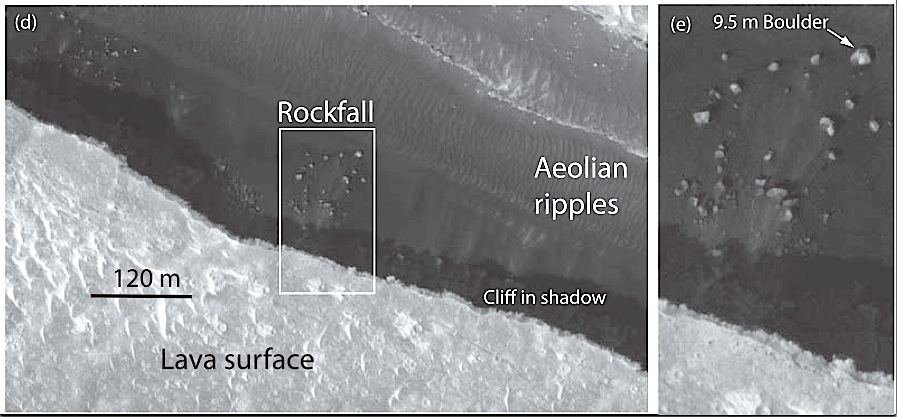
A new investigation of Cerberus Fossae using HiRISE images shows that Mars is probably seismically active now or in the recent past. The clues are tracks left by boulders as they rolled downhill.

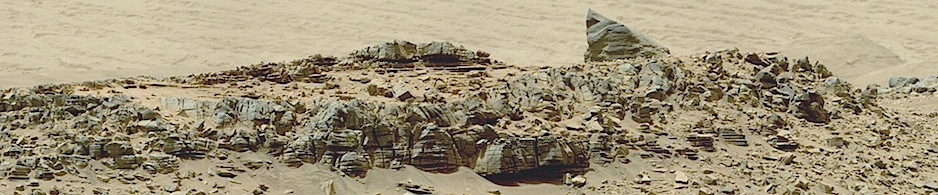
WATCH OUT BELOW. A small area of a lava cliff a few tens of meters high spawned a rockfall that scattered boulders into one part of Cerberus Fossae in this HiRISE image. The lingering boulder trails indicate there has been little wind erosion or deposition since the rockfall. The fact that the biggest boulder lies farthest from the source area suggests a high-speed, single event. (Image is taken from Figure 2 in the paper.)

Gerald Roberts (University of London) and colleagues write in the Journal of Geophysical Research that, “Boulders from the youngest sub-population we can resolve have left boulder trails as they rolled and bounced down slopes. These boulder trails have not been erased by eolian processes that we know are active on Mars. This suggests that the fallen boulders, and hence putative marsquakes may be an ongoing feature of Mars.”

Cerberus Fossae is a pair of long fractures that cut across the Athabasca Valles outflow channel in the Elysium volcanic province. The team notes that Cerberus is one of the youngest fracture and graben systems on the Martian surface, perhaps volcanically active in the last 2 million years. (A study published in 2011 suggested that the crack was emitting residual geothermal heat.)

As the Cerberus fractures grew, they developed a 500-meter (1650-foot) offset in the Athabasca channel. Images taken with the HiRISE camera show numerous places where boulders falling from the lava-cliff rim rock spilled into the fracture, leaving bounce marks and trails down the slope. In many cases, these trails appear fresh and unchanged by wind erosion.

The scientists note, “Other rockfall boulders do not have boulder trails leading to them, presumably because the boulder falls are older, so that their boulder trails have been obscured or covered” by ongoing wind erosion and deposition. The team compared the Martian rockfalls with those resulting from a 2009 earthquake near L’Aquila, in central Italy.

What caused the Cerberus rockfalls? After looking at melting ice or thermal stresses caused by solar heating, the scientists say, “Overall, we conclude that ground shaking associated with paleomarsquakes is a plausible mechanism that could produce the boulder size distributions we have described.”

Images of Cerberus showed displaced boulders ranging from 2 to 20 meters (6.5 to 65 feet) in diameter. Their size and number decreased over a distance of 100 kilometers (62 miles) centered at a point along the Cerberus Fossae faults. Roberts says, “This is consistent with the hypothesis that boulders had been mobilized by ground-shaking, and that the severity of the ground-shaking decreased away from the epicenters of marsquakes.”

In the Italian quake, boulder falls occurred up to about 50 km (31 miles) from the epicenter. Because the area of displaced boulders in Cerberus extended across an area approximately 200 km (124 miles) long, the marsquakes likely had a magnitude greater than 7, the researchers estimated.

As to how frequent the quakes were, the scientists write, “We envisage that not just one paleomarsquake, but rather a sequence of paleomarsquakes will have produced the boulder falls we have studied, and ultimately the roughly 500 meters of vertical offset that has accumulated across Cerberus Fossae since formation of the Athabasca Valles outflow channel.”

Posted in Reports | Tagged , , , , , , , , , , | Comments Off

Ice cap winds spread polar gypsum

The north polar cap of Mars is surrounded by a vast dune field, about as large as Earth’s Kalahari Desert, that contains extensive deposits of gypsum. The gypsum’s origin has been debated since the mineral was discovered in 2005, yet because gypsum crystals are fragile, they must have originated not far from where they now lie.

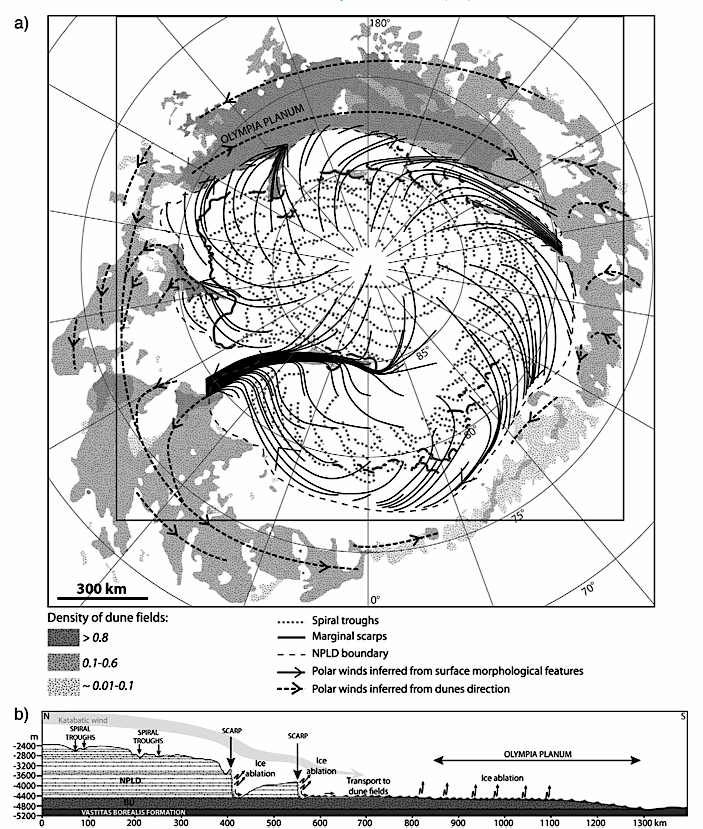
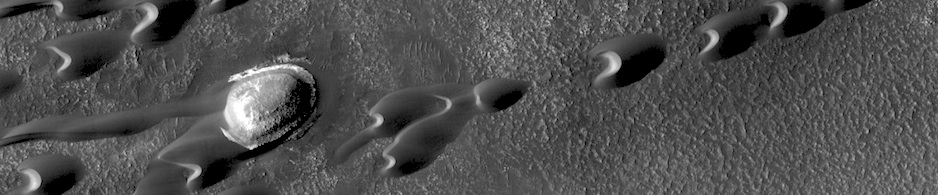
POWERFUL WINDS come off the ice cap and accelerate down its slopes along the spiral troughs and scarps that cut into the cap. The winds erode the ice, freeing sand, dust, and gypsum from the cap's internal layers and also from the ice- and sediment-rich basal unit. (Image is Figure 7 from the paper.)

A group of geologists led by Marion Massé (Université de Nantes) is proposing (Earth and Planetary Science Letters) that the gypsum comes from two source areas: the so-called basal unit that underlies the entire polar cap, and layers of sediments embedded within the ice cap.

The team writes, “Previous work has suggested that gypsum crystals trapped in the north polar cap formed initially by weathering of dust particles, either in the atmosphere prior to their deposition during the formation of the ice cap, and/or in the ice cap after their deposition.”

The polar cap lies in the lowest part of the northern topographic basin, the scientists note. The cap is 1,300 kilometers (750 miles) in diameter and reaches a maximum thickness of 3 km (2 mi) at its center. The whole ice cap formed during the Amazonian (the last 2.8 billion years), and its upper (younger) parts form a stack of water-ice layers mixed with varying amounts of dust and sand. The layers result from cycles of climatic change.

Lying under the ice cap and extending a distance beyond it lies a dark formation roughly a kilometer thick named the basal unit. It contains sequences of ice- and sediment-rich layers.

The scientists examined the mineral composition of the dune fields around the ice cap using data from the OMEGA and CRISM imaging spectrometers. They found that while the gypsum is especially prevalent in the Olympia Planum area, the mineral lies everywhere in the circumpolar dune field.

Next they examined wind patterns over and around the polar ice. Winds descend over the ice cap and spread outward, following scarps and troughs which they have eroded into the ice cap. The winds cause the ice to sublimate, releasing sediments caught in the ice and transporting them outward into the dune field. The basal unit responds the same way and releases its sediments as well.

Of the two sources for gypsum, the scientists find that the basal unit, being richer in dust, sand, and sediment, contributes the most. As the scientists explain, the intensity of the gypsum spectral bands decreases as the distance from the basal unit increases. “This suggests that the basal unit is the major source of gypsum for the dunes.”

Posted in Reports | Tagged , , , , , , , , , , , | Comments Off

Water-carved channels on crater debris

Medium-size craters less than 3 billion years old often show water-carved channels in their debris aprons, according to a new study of mid-latitude craters in Arabia Terra. Previous studies had reported that such features on ejecta aprons were rare.

THE CERULLI CRATER IMPACT obliterated part of Mamers Vallis, but fluvial activity and landforms appear on both the debris apron around the crater and on the crater's inside walls. (Image is Figure 1 from the paper.)

Nicolas Mangold (Université de Nantes, France) writes in Planetary and Space Science that 27 craters (out of 204 studied) show water-carved channels on their ejecta blankets. He notes that these fluvial landforms appeared with craters larger than 12 km (7.5 miles) in diameter; they also appeared on the inner rims of a few craters larger than 90 km (56 mi) in diameter.

“A process of shallow ice melted below warm ejecta can explain most of these observations,” Mangold notes, adding that snow deposits and subsequent melting, as well as impact-caused hydrothermal activity may be associated with this process, especially for the largest craters.

The study used images taken with the High Resolution Stereo Camera (HRSC) on Mars Express and the Context Camera (CTX) on the Mars Reconnaissance Orbiter.

Mangold adds, “Crater counts suggest fluvial activity was scattered from the Early Hesperian to the Middle Amazonian. So these landforms on preserved ejecta blankets can be used as a new way of determining when water was available on Mars.”

Posted in Reports | Tagged , , , , , , , , , | Comments Off

Phoenix lander soil: dry for a long, long time

NASA’s Phoenix  spacecraft landed on the high northern plains of Mars. Among its instruments were optical and atomic-force microscopes. A team of scientists led by Tom Pike (Imperial College, London) used these to measure the size and number of particles in samples of Martian soil at the lander site. Such studies of a soil’s microstructure can reveal the processes that formed the soil, including any interactions with liquid water.

MARS DIRT has a different microstructure than Earth dirt, as explored by microscopic imaging by the Phoenix lander. This view shows several trenching sites studied. Besides the soil being dry for half a billion years, the scientists found that lunar soil makes a closer match in microstructure to Mars soil than Earth's does. (Image is taken from Figure 1 in the paper.)

The results, published in Geophysical Research Letters, suggest that the Phoenix soil has felt the touch of liquid water for, at most, no more than 5,000 years out of the last 600 million years. That’s the age of Heimdal Crater, whose ejecta blanket Phoenix landed upon.

“The Phoenix soil samples appear to originate from a well-mixed material typical of the Martian surface,” say the researchers. While ice lies just under the surface, the landing site is in an area of Mars where neither erosion nor deposition dominate, and the wind is the most important agent in moving soil particles.

To explore how long the soil has been dry, the scientists studied clay-size particles, those with diameters less than a few micrometers. Terrestrial soils have a distinctive signature from interactions with water: a sharp dropoff in the number of particles below 1 micrometer in size. Although microscope images revealed the Phoenix soil had such a falloff, it was at 10 micrometers, much too large to be explained by water-related clay formation.

Lead author Pike adds, “We confirmed that a copy of the flight hardware could identify this clay signature in our test samples on Earth. But there’s no sign of it in the Martian samples.” Experiments show that to get a soil with 6 percent phyllosilicate clays would take up to 400,000 years’ contact with liquid water to develop.

“As less than 0.05 percent of the Martian soil is of a size consistent with phyllosilicates,” the team says, “this implies the soil has seen at the very most a total of 5,000 years of liquid water in its history, and probably much less.”

The researchers conclude, “A globally homogenous soil with such a microstructure would be an unlikely habitat for the propagation of life on Mars.”

Posted in Reports | Tagged , , , , , | Comments Off