

What turned off the Martian magnetic field?

For roughly the first 500 to 800 million years of its existence, Mars had a magnetic field generated by a natural internal dynamo. This was powered by convection currents in the planet’s molten iron core, which operated vigorously as they unloaded heat into the overlying mantle, where its own convection currents carried it up to the surface.
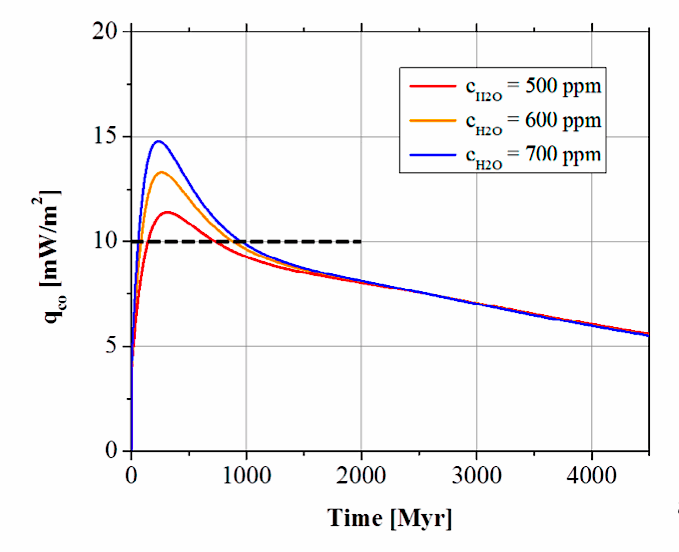
DRYING OUT THE MANTLE. As the Martian mantle gave up water and volatile gases to the surface, it became stiffer and less able to carry heat from the core. The color curves show the mantle's cooling rate given various amounts of water within it. After about a billion years, the heat flow dropped below the threshold to sustain a dynamo, as indicated by the heavy black line. (Image is Figure 3a from the paper.)

But the dynamo shut down for unknown reasons, and scientists have not understood why. Possible causes include disrupting the mantle’s convection currents by the heat from large impacts.

Constantin Sandu and Walter Kiefer (both Lunar and Planetary Institute) now propose in a paper in Geophysical Research Letters that driving water and volatile elements out of the mantle through volcanism could have been the culprit. In their scenario, the volcanic activity initially cooled the mantle, helping it to convey heat from the core, which enhanced the core’s heat flow and maintained the geodynamo.

But they note that as the mantle cooled and gave up its water and gases, it became stiffer, less convective, and less able to carry away heat. This in turn diminished the core’s ability to cool, making it less convective — and putting a damper on the dynamo that generated the magnetic field.

They write, “An initially wet mantle will promote strong convection, rapid core cooling, and dynamo activity.” But erupting water and volatiles onto the surface, plus overall planetary cooling, increased the mantle’s viscosity. This decreased the rate of core cooling and possibly shut down the dynamo activity.

Posted in Reports | Tagged , , , , , , , , | Comments Off

Did big impacts disrupt heat flow in the Martian mantle?

Mars shows more than 20 impact basins with diameters of at least 1,000 kilometers (600 miles), and five of these are 2,500 km wide or larger. Based on crater counts, most of the basins appear to have occurred between in a narrow slice of time, 4.2 to 4.1 billion years ago. This is about when scientists believe the internal dynamo creating a global Martian magnetic field turned off. Is there a connection?

Possibly, argue James Roberts (Johns Hopkins University Applied Physics Laboratory) and Jafar Arkani-Hamed (University of Toronto) in a recent paper in Icarus. Their work involved computer modeling of the thermal effects on the convection in the Martian mantle caused by large impacts.

They write, “We find that the impacts that formed the five largest basins dominate the impact-driven effects on mantle dynamics. A single impact of this size can alter the entire flow field of the mantle. Such an impact promotes the formation of an upwelling beneath the impact site, resulting in long-lived single-plume convection.” A mantle plume is an upwelling of warm, buoyant rock that transports material and heat from the deep mantle to the near-surface.

Also, the researchers note, the basin impacts came too frequently for the mantle to relax and re-establish its normal convection pattern.

“The interval between the largest impacts (about 25 million years) is shorter than the initial recovery time for a single impact (roughly 100 million years),” they explain. “Hence, the change in convective pattern due to each impact sets up a long-term change in the global heat flow.”

Earlier work suggests that the impact heating produces a warm region, or ‘thermal blanket’ in the interior, preventing the deeper layers from cooling and thereby stalling the dynamo activity in the core that generates the magnetic field.

Posted in Reports | Tagged , , , , , | Comments Off

MARSIS detects “Oceanus Borealis” sediments

The ground-penetrating radar instrument MARSIS on the Mars Express orbiter has measured the electrical properties of the north and south polar regions. The results, reported in Geophysical Research Letters by Jérémie Mouginot (University of California, Irvine) and colleagues, strongly support the idea that the Martian northern plains once held a large body of water.

POLAR OCEAN FLOOR? Cool colors map the location of surface materials with low dielectric constants, indicating where ancient ocean sediments may lie. Warm colors point to areas with high dielectric constants, such as the volcanic rocks of Elysium and the heavily cratered terrain in Noachis. Isidis is a small impact basin likely flooded by outflow channels or spillover from the northern ocean. (Image is Figure 2 from the paper.)

The hypothetical northern ocean — sometimes dubbed Oceanus Borealis — is not a new idea, and scientists have long argued both for and against it. Consensus identifies the Vastitas Borealis Formation, which occupies much of the northern lowlands, as a roughly 100-meter thick sedimentary veneer that overlies volcanic ridged plains. It lies within the proposed shorelines for the ancient ocean. (In 2008, NASA’s Phoenix lander set down on one part of the formation and found water ice just a few inches below the dry surface soil.)

“As such,” say the researchers, “the formation represents the best geologic evidence to date for the existence of an ocean in the Late Hesperian, about 3 billion years ago.”

The MARSIS radar mapped the dielectric constant of the surface materials down to a depth of roughly 100 meters (yards). As measured by the radar, dense volcanic rock would have a dielectric constant of around 10 and pure ice would have a value of 3.1. The Vastitas Borealis Formation shows values of 4 to 5. At the same time, volcanic flows in Elysium have values of around 9 and the cratered highlands of Noachis Terra show values of 10 and higher.

“Although much is still unknown about the evolution and environmental context of a Late Hesperian ocean,” the team writes, “our observations provide persuasive evidence of its existence by the measurement of a dielectric constant of the Vastitas Borealis Formation that is sufficiently low that it can only be explained by the widespread deposition of (now desiccated) aqueous sediments or sediments mixed with massive ice.”

Where did the ocean go? The researchers point to two possible fates. “The water that once filled the Late Hesperian ocean may have either sublimed into the atmosphere (and become cold-trapped elsewhere on the planet), or it froze in place and is preserved underground.”

Posted in Reports | Tagged , , , , , , | 3 Comments

Did Tharsis change its volcanic style?

Volcanic activity on Mars tends toward an “effusive” eruption style: it produces many low-profile, broad-skirted volcanos. These are made with sheets of runny lavas that flow like warm motor oil for long distances, spilling over and around obstacles or burying them. Tharsis, home to the biggest volcano in the solar system, Olympus Mons, is a gigantic outdoor museum of this volcanic style.

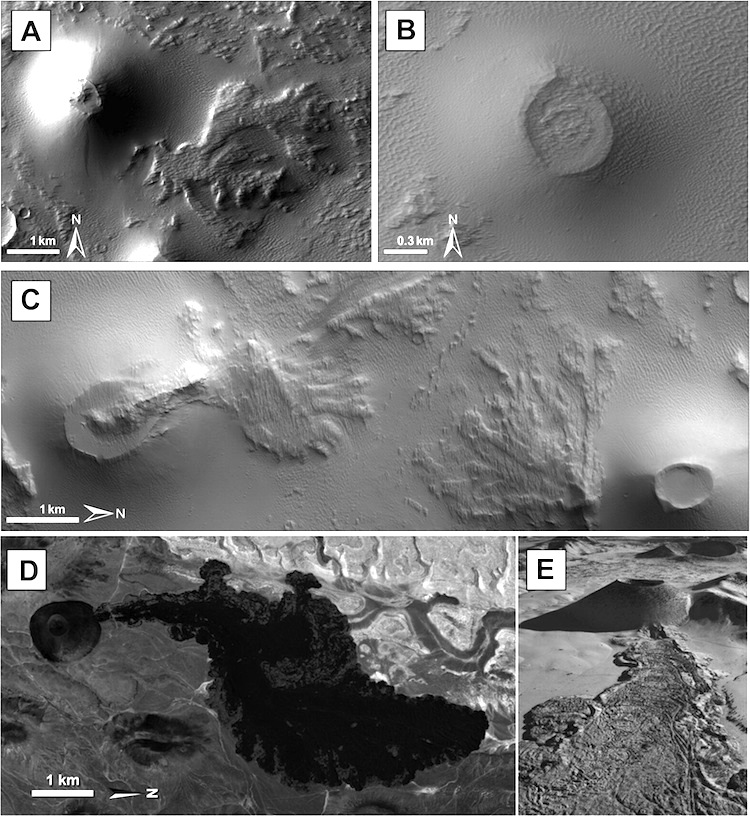
CINDER CONES IN THARSIS. Images A, B, and C show cinder cones with short, blocky lava flows in the Tharsis volcanic field on Mars. Images D and E show two views of SP Crater, a 70,000-year-old cone in the San Francisco volcanic field near Flagstaff, Arizona. (Image is Figure 3 in the paper.)

By contrast, evidence is relatively rare on Mars for explosive (“pyroclastic”) eruptions, which typically build small, steep-sided cinder cones that give birth to lava flows that are stiff, blocky, and short.

Yet within Tharsis, scientists Petr Broz (Academy of Sciences of the Czech Republic) and Ernst Hauber (DLR, Berlin) have found a small volcanic field dotted with pyroclastic cones. More intriguing, it is slightly elevated over its surroundings. This meant the area escaped being flooded by the usual kind of Tharsis lava flows and thus it preserves a remnant of an earlier eruption style.

“The cone field is superposed on an old, elevated window of fractured crust which survived flooding by younger lava flows,” they explain in their report, published in Icarus.

The cinder cone field lies on the southeast edge of Ulysses Fossae, a fault system several hundred kilometers long, that lies north of two large volcanos, Biblis Patera and Ulysses Patera. The cinder cones clearly align along the fractures, and likely erupted when the faults cracked and opened.

The researchers note that because of the cinder cones’ small size, their age is hard to pin down, but they estimate they formed between 440 million and 1.5 billion years ago. The scientists add that due to heavy coatings of dust, which is common in Tharsis, the individual cinder cones unfortunately display too few details to sort them into an age sequence.

Broz and Hauber remark, “It’s surprising that this is the only well-preserved cinder cone field of this kind seen so far on Mars, given that pyroclastic cones are the most common volcanos on Earth.” One explanation, they note, is that these fields may have been more numerous long ago on Mars.

“It seems possible that a more explosive eruption style was common in the past,” they say, “And that the widespread effusive plains-style volcanism in the Late Amazonian has buried much of its morphological evidence in Tharsis.”

Posted in Reports | Tagged , , , , | Comments Off

Mini pedestal craters suggest tropical ice deposits

MINI-PEDESTAL CRATERS formed when small meteorites struck an ice-rich deposit in Daedalia Planum. They lie at a latitude where scientists have thought ice deposits were not present in Mars' recent geologic history. The white scale bars in each image are 10 meters (33 feet) long. (The image is from Figure 3 in the paper.)

Craters surrounded by debris aprons that stand above the surrounding surface are known as pedestal craters. Scientists think the slab-like apron of ejecta around such craters covers layers that are rich in water ice. Nearly all pedestal craters found so far have been in middle to high latitudes, where scientists know ice exists at shallow depths

Now a group of small, young pedestal craters has been identified in images from the HiRISE camera on NASA’s Mars Reconnaissance Orbiter. These craters lie in the Martian tropics, where scientists have thought annual warmth would have long since removed any shallow ice.

Samuel Schon and James Head (Brown University both) report in the February 2012 Earth and Planetary Science Letters on a population of pedestal craters with diameters of a few tens of meters (hundreds of feet) in Daedalia Planum at 23° south latitude.

The craters formed by impacts into an ice-rich deposit that formed on top of the ejecta apron around a larger crater (5.3 kilometers or 3.3 miles) across. This crater is only 12 to 13 million years old. The researchers envision that the small impacts dug through the ice-rich deposit into the underlying material. The outflung debris from the small impacts preserved a portion of the ice-rich deposit under their own ejecta blankets. The result was a handful of mini-pedestal craters matching in form those seen elsewhere at higher latitude, but much smaller in size.

Regarding when in the last 12 million years the pedestal craters formed, the scientists can’t say for sure, but they offer some possible answers. “The pedestal craters could have formed during the most recent Martian ice age, dated to 400,000 to 2.1 million years ago. However, we suggest that formation is more likely to have occurred during a period of higher mean obliquity before 5 million years ago, during which time the Martian axis often approached 45° obliquity. These older more extreme obliquity conditions are consistent with global climate modeling for equatorial ice deposits.”

If the interpretation is right, say the authors, “these small pedestal craters formed when a meters-thick layer of ice was present in the tropics of Mars in the last few million years.”

Posted in Reports | Tagged , , , , , , | Comments Off

Home Plate’s volcanic bomb landed with a splat

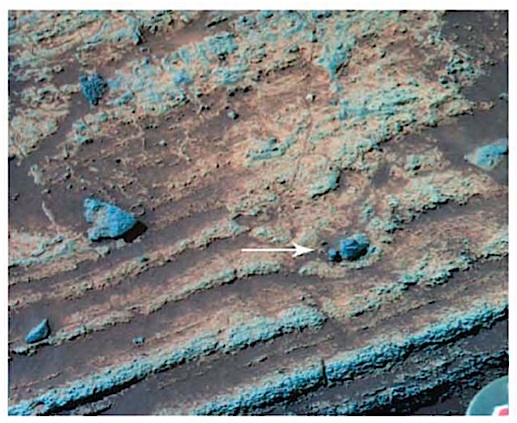
One of the unusual features that Mars Exploration Rover Spirit discovered at Home Plate, a former hydrothermal vent in the Columbia Hills, was a “bomb sag,” complete with its partially embedded volcanic bomb. To geologists, volcanic bombs are rocks or debris tossed in the air by eruptions, and a bomb sag is the crater that forms when a bomb hits the ground.

IT HIT WET GROUND. A small rock (arrow), about 1.5 inches wide, was thrown into the air by a volcanic explosion near Home Plate in the Columbia Hills. When this "volcanic bomb" landed on layered sediments, it made a tiny crater less than an inch deep. Experiments with similarly sized projectiles led the researchers to conclude the sediments were soaking wet when the rock landed. (Image is Figure 1a from the paper.)

Michael Manga (University of California, Berkeley) led a team of scientists who used the bomb sag to investigate conditions at Home Plate when it formed. Specifically, they wanted to know how dense the atmosphere was when the bomb landed and how saturated the sediments were. The report on their lab experiments appears in Geophysical Research Letters.

“To create laboratory bomb sags, we propelled centimeter-sized particles with compressed air towards layered beds of sand-sized particles,” they write. Some sand beds they kept dry, others were damp, still others were thoroughly wet. The best fit they found was with water-saturated sand, implying the same for Home Plate.

The team then calculated likely atmospheric densities, starting with some assumptions about the rock’s mass, volcanic source, and impact velocity. While acknowledging the uncertainties, Manga’s team concluded that the minimum atmospheric density at the time of impact was about 20 times higher than the Martian atmosphere currently has.

The researchers caution that this is just a single observation made at a site whose age is known only poorly.

Posted in Reports | Tagged , , , , , , , , | 1 Comment

No flow found in north polar ice layers

The northern polar ice cap of Mars contains a thick stack of layers rich in water ice. Under the right conditions ice can flow, as seen in ice sheets and glaciers on Earth. What about Mars?

A group of scientists led by Nanna Karlsson (University of Copenhagen) used SHARAD radar images showing the layers inside the Martian north polar ice cap to build a 3D computer model. They examined the layers at Gemina Lingula, the southernmost part of the layered deposits, seeking to compare the model with the radar layers and look for evidence of flow.

However, writing in Geophysical Research Letters, they report that they found no compelling evidence in the layers’ structure that ice flowed between the main ice dome of the polar cap and Gemina Lingula. This implies, they conclude, that the current shape and form of the layered deposits are mainly controlled by the ordinary processes of erosion and deposition. Also, they write that “the north polar layered deposits have not been subjected to substantially warmer temperatures in the past.”

Posted in Reports | Tagged , , , | Comments Off

More dust devilry in the air

Dust devils are the most dynamic feature on Mars, and scientists are zeroing in on how they work. An earlier Red Planet Report described dust devil motions as mapped by fortuitous simultaneous observations by cameras on two separate spacecraft.

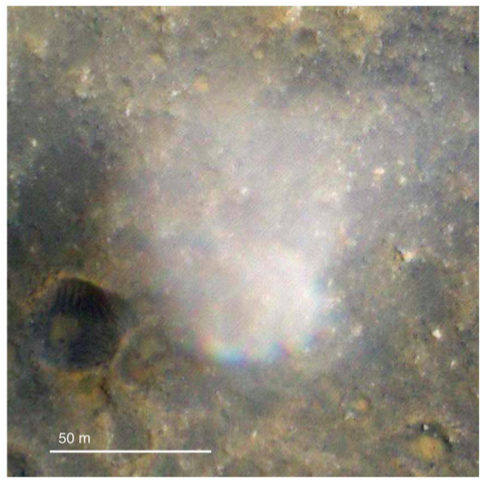
COLOR EQUALS MOVEMENT. After combining frames into a color composite image, a moving dust cloud produces rainbow fringes towards the bottom of this dust devil, as caught in HiRISE frame ESP_021925_1650. (Image is Figure 2 from the paper.)

Now, David Choi (NASA Goddard Space Flight Center) and Colin Dundas (USGS Flagstaff), report in Geophysical Research Letters about dust devil velocity measurements they made using only the HiRISE camera on NASA’s Mars Reconnaissance Orbiter.

“The central color swath of the HiRISE instrument has three separate CCD sensors and color filters,” they note. “These observe the surface in rapid cadence, about a tenth of a second apart.”

This makes active features, such as dust devils or avalanches, appear to move like a flip movie when the individual images are animated. Choi and Dundas note that they can track the movement of details in dust devil clouds to get horizontal wind measurements.

The scientists note that they tracked the speeds in four dust devils. These ranged in size from 25 to 250 meters in diameter (82 to 820 feet), and reached altitudes of 150 to 650 meters (490 to 2100 feet). The wind velocities were mostly in the range of 20 to 30 meters/sec (45 to 67 mph), with maximums near 45 m/s (100 mph).

“Typically, the strongest winds occur along the outer edge of a dust devil, regardless of its diameter,” they report. These figures are in general agreement with previous observations made from orbit and from the Martian surface.

Choi and Dundas also report that the cores of the dust devils show a slightly reduced air pressure (about 1 percent), which they note is enough to lift dust from the surface and help it become caught up in the whirlwind.

Posted in Reports | Tagged , , , , | Comments Off

Microbes in a cave, eating rock

Life abounds on Earth, where it lives in every possible ecological niche, including deep in the crust. This comes from biology’s reproductive drive plus natural selection’s creativity in matching organisms’ needs with what nature provides.

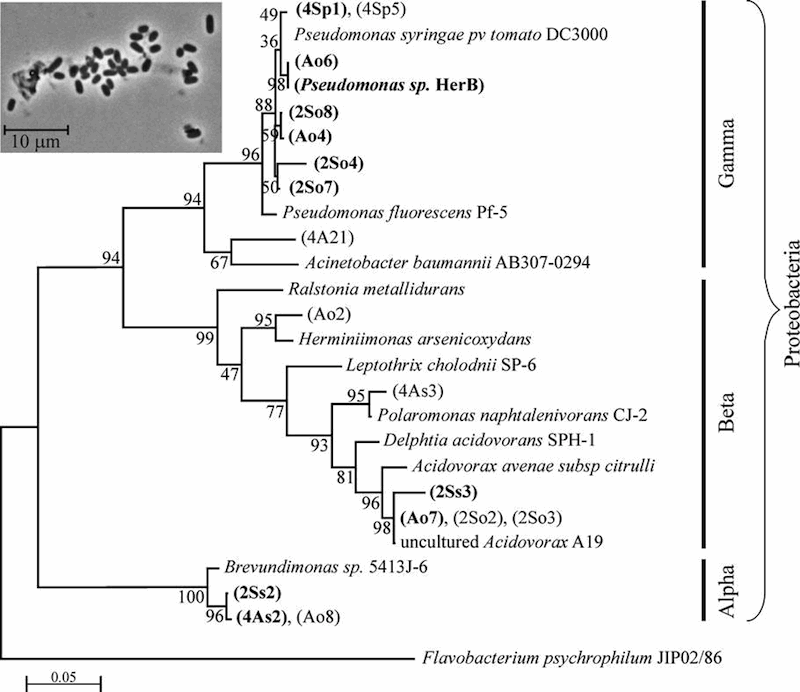
ROCK ENERGY. A phylogenetic tree showing in bold face the microbes, including Pseudomonas, that grew when incubated in a mineral medium with olivine as the sole source of energy. (Image is Figure 2 from the paper.)

But what about Mars, where the environment is markedly harsher than almost any on Earth? A new paper in Astrobiology by a group of scientists led by Radu Popa (Portland State University) describes a common Earth microorganism that’s thriving under conditions approaching those on Mars. The microbe is a bacterium (Pseudomonas sp. HerB) that lives on rock and ice in a lava tube on Newberry volcano in the Oregon Cascades.

In a laboratory at room temperature and normal oxygen levels, the scientists found that the microbes consumes organic material (sugars). But when the researchers removed the organic material, reduced temperatures to near-freezing, and lowered the oxygen levels, the microbes began to use the iron from olivine — a silicate mineral widely found in volcanic rocks on Earth and Mars — as its energy source.

“This reaction involving a common igneous mineral hasn’t been documented before,” says Martin Fisk (Oregon State University), an author on the study. “In volcanic rocks directly exposed to air and at warmer temperatures, the oxygen in the atmosphere oxidizes the iron before the microbes can use it. But in the lava tube, where the bacteria are covered in ice and sheltered from the atmosphere, they out-compete the oxygen for the iron.”

Conditions in the Oregon lava tube are not as harsh as on Mars, Fisk acknowledges. “On Mars, temperatures rarely rise above the freezing point of water, oxygen levels are lower, and at the surface, liquid water is not present. But water is hypothesized to be present in the warmer subsurface of Mars.”

“The metabolic capabilities of this bacterium would allow it to live in near-surface, icy, volcanic environments of Mars in the present or recent geological past,” say the researchers. “This type of physiology is a prime candidate in the search for life on Mars.”

Posted in Reports | Tagged , , , , , , | Comments Off

Polar gullies erode from carbon dioxide flows

Gullies on Martian slopes form by flowing water, most probably trickles of snowmelt or groundwater. But what about the gullies found in places such as the high latitudes and polar regions where temperatures never rise above the freezing point for water?

GROOVY GULLIES. Bright frost has collected (left) on slopes facing away from the Sun in a southern polar pit (latitude 68.5° south). At center, dark streaks mark where gullies lie in on a dune at 70.3° south. At right is a gully formed experimentally with gas fluidizing dry sand. (Image is Figure S1 from the paper.)

A new paper in Geophysical Research Letters offers flows of carbon dioxide gas as the eroding fluid instead of liquid water.

Yolanda Cedillo-Flores (Universidad Nacional Autonoma de Mexico) and three other planetary scientists propose that CO2 gas could pick up and carry loose sediment (sand and dust-size particles) downslope, eroding small gullies. The CO2 would come from seasonal frost that sublimates (passes from ice crystals directly into a gas) as local spring arrives.

“For polar gully landforms to be initiated by fluidization of CO2, slopes mantled in annual CO2 frosts must be covered by sediment, sand, or dust,” they explain. This can be met only under restricted conditions: “It requires a pole-facing slope (such as a crater wall or dune) to develop a seasonal cover of CO2 frost. Surface winds could then cause sediment to blow in from nearby equator-facing slopes and be deposited on the frosted pole-facing slopes, thus burying the CO2 frost beneath the sediment.”

At that point, the stage is set. When the Sun starts shining on the slopes early in local spring, solar heat is absorbed by the sediments and conducted into the underlying CO2 frost. This sublimates in response. And if gas velocities in sublimation become high enough, the overlying sediment can be fluidized and flow downhill, starting the erosion of a gully.

The scientists caution that gullies in polar and temperate latitudes show similar ranges of sizes and shapes, consistent with formation by a common mechanism. However, they note, “Similar gully morphologies can also arise in liquid-rich flows which suggests that gullies can be initiated by multiple processes — and that, once begun, the flow process in gully-forming avalanches is independent of how the flow was initiated.”

Posted in Reports | Tagged , , , , , , | Comments Off