



A polar ocean leaves few clay deposits

The northern lowlands of Mars have long invited the notion that in ancient times they once contained a now-vanished polar ocean. Yet a longstanding argument against such was the lack of widespread clay minerals that would naturally occur with such a large body of water.
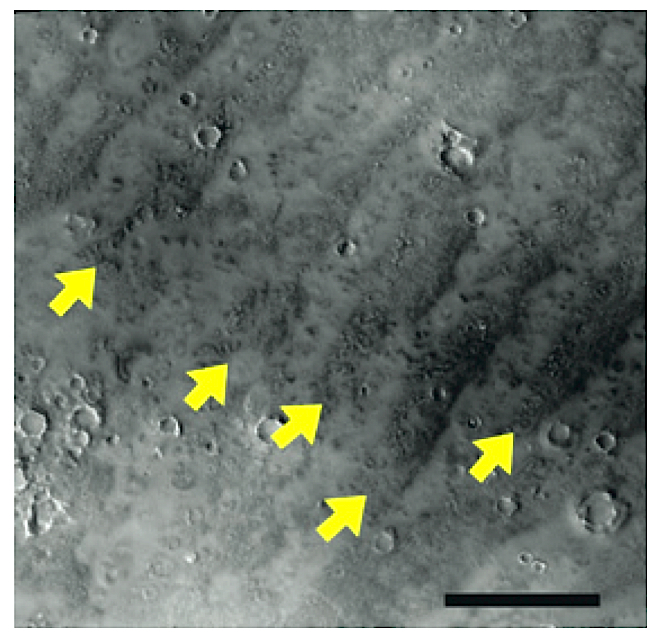
GLACIER MORAINES. Boulder-covered ridges (yellow arrows) left by glaciers lie in the lowlands near northwestern Arabia Terra, in this image from the HiRISE camera on the Mars Reconnaissance Orbiter. Glaciers filling valleys at the highlands-lowlands boundary would have blocked the flow of water carrying clay minerals into the northern lowlands. (Taken from Figure 2 in the paper.)

Clays, for example, are extremely common in ocean sediments on Earth, but are detected only rarely in the ancient basement rocks of the northern lowlands of Mars. At the same time, clay minerals appear at thousands of locations in the Martian highlands.

Alberto Fairén (SETI Institute and NASA Ames Research Center) and colleagues now say that this argument against a northern ocean is not as conclusive as thought.

Writing in Nature Geoscience, they say that any Martian polar ocean would be partially frozen over and have internal temperatures near freezing. Under these conditions, the researchers’ computer models show that clays would be unlikely to form.

In addition, they note the shores of a polar ocean would be choked with glacier ice producing little or no meltwater. This would prevent clay minerals that developed in the highlands from washing down into the northern ocean.

On Earth, more than 90 percent of marine clay sediments come from rivers draining the continents. Early Mars had relatively warm temperatures and tens of thousands of rivers flowing through the highlands, the team explains. The combination produced abundant clay minerals all over the tropical highlands. “Clays transported by these river valleys from the highlands to the lowlands are thus theoretically expected to be widespread in the northern plains, but they are not present.” The reason, they say, is that glacier ice in the valleys rimming the northern ocean blocked the sediments.

And what about the weathering effect of a northern ocean on basaltic rocks within the ocean basin? The researchers noted that any ocean would be partially ice-covered and the water would have near-freezing temperatures. This means that the chemical reactions producing clays by weathering basalt would either cease or run only very slowly.

“Our model results show that clays are a significant component at the beginning, but they become residual with time and the associated drop in temperature,” they explain. “A system containing basalt and water evolving towards subzero temperatures would finally preclude the formation of clays.”

Posted in Reports | Tagged , , , , | Comments Off

Hadriaca Patera’s heavy footprint

On the northeast edge of the giant Hellas impact basin, the thick stack of lava in the volcano Hadriaca Patera weighed so much it depressed the Martian surface immediately around it. This bent and cracked the crust on the volcano’s eastern and southern sides.

GROUNDWATER EMERGED inside a trough on the southeast side of Hadriaca Patera volcano. As the water flowed southwest into the Hellas basin, it eroded the outflow channels of Dao and Niger Valles. (Taken from Figure 5 in the paper.)

Groundwater in the area, already under pressure, burst to the surface and ran down into the Hellas basin. On its way, the water eroded two large valleys — Dao Vallis and Niger Vallis.

That’s the outline scenario developed by Stefanie Musiol (Freie Universität Berlin) and colleagues, and published in the Journal of Geophysical Research. They used both topographic elevation data from the High Resolution Stereo Camera (HRSC) on the Mars Express orbiter and computer modeling to investigate the geophysical forces and their effects.

The Hellas impact occurred around 4 billion years ago, and scientists think that Hadriaca was erupting off and on between 3.9 and 3.5 billion years ago. (Hadriaca, with a diameter of about 450 kilometers, is part of a group of volcanos flanking Hellas that are the oldest known on Mars.)

According to the researchers, the weight of Hadriaca’s lava alone wasn’t sufficient to cause an outburst of groundwater. They found that a pressurized aquifer that could have developed in a broad trough reaching from Hellas northeast into Hesperia is also required. The downwarping of crust due to the increasing load as Hadriaca grew cracked the crust and released the pressurized groundwater on the volcano’s southeast side. As the water flowed toward the Hellas basin, it eroded Dao and Niger Valles.

But the flow, the researchers explain, probably wasn’t a single gigantic flood. “We suggest that Dao and Niger Valles source regions originated as flowing wells.” The valley floors do not show the telltale high-energy features — scouring, giant ripple marks — seen in many other outflow channels.

The team concludes, “One or more progressive outflow events involving several source regions, rather than a catastrophic flooding event from a single source, can explain Dao and Niger Valles.”

Posted in Reports | Tagged , , , , , , , , | Comments Off

About that mound in Gale Crater…

Next August, if plans go right, the Mars Science Laboratory rover, named Curiosity, will come sailing out of the Martian sky and power in for a soft landing on the floor of Gale Crater. Launched to look for geologic evidence of habitable enviroments, what will Curiosity find?

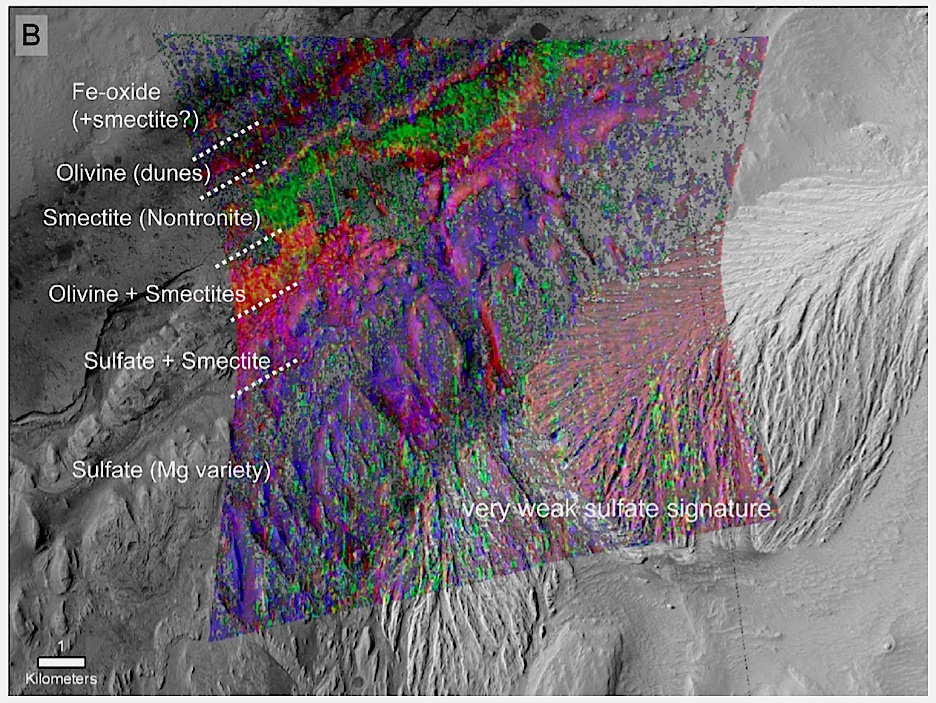
GLOBAL SHIFT. A change in weathering chamistry is reflected as the lower layers of sediment in Gale's mound were overlain by later ones. The former are rich in water-altered clays such as smectite, while latter layers contain sulfates that formed in a more acidic environment. Project scientists and engineers expect that Curiosity will be able to explore the layers in this canyon scene. (Image taken from figure 10B in the paper.)

NASA picked Gale in part because the northern half of its floor appears as safe a landing zone as the Gusev plains where MER Spirit set down in 2004. However, the main reason for choosing Gale is the giant mound of sediments filling a large part of the crater. It rises 5,200 meters (17,000 feet) and spreads 45 by 90 km (28 by 56 mi).

B. J. Thomson (Boston University) and nine colleagues examine the mound’s age, history, structure, and composition in a newly published paper in the August 2011 issue of Icarus.

The team used data from CRISM, HiRISE, THEMIS, and other instruments to draw a portrait of the mound, identifying 22 individual geologic units grouped into two major formations. They note the lower and older formation displays “abundant evidence for aqueous activity,” a key virtue for Curiosity’s mission.

Spectroscopic data show the lower layers contain clays mixed with a few sulfates. Toward the top of the lower formation and continuing into the upper formation, the layers change into sulfate-bearing strata. The researchers say the changeover may reflect a global shift from a warmer and chemically neutral weathering environment to a colder and more acidic one.

The boundary between the two formations marks a gap in geologic history of unknown length. By counting craters, the team finds that Gale Crater formed at the end of the Noachian era, or about 3.8 billion years ago. The mound cannot be any older than that.

At the other end of the date range, the mound’s youngest surfaces appear roughly 2.8 billion years old. But the scientists caution that its materials erode easily and don’t retain craters for age-dating very well, thus the mound is in fact older than it looks. (Think geological botox.)

Whatever the mound’s exact age, however, it will be a striking site for Curiosity to visit. Moreover, says the team, “Gale provides a unique opportunity to investigate global environmental change during a period of transition.”

Posted in Reports | Tagged , , , , , | Comments Off

Cracks in the basement

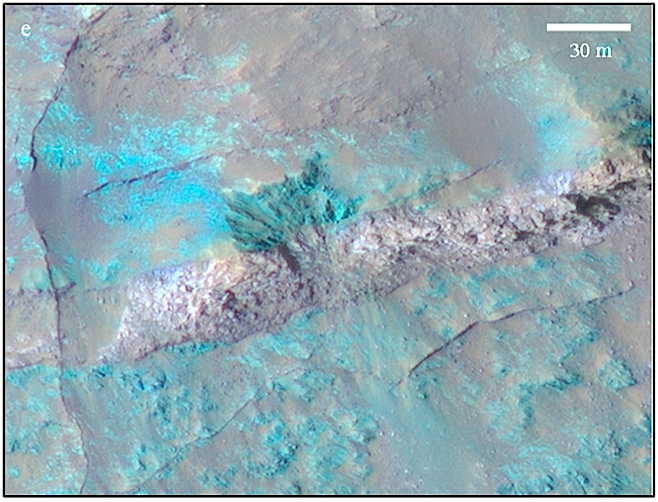
When geological forces open a crack in bedrock, molten magma can squeeze in and widen it, after which the magma cools and hardens in place. The result is a dike, and such features let geologists delve into an outcrop’s history by exposing rocks of different compositions and ages.

PLUGGED CRACK. An igneous dike 30 meters (100 ft) wide cuts across part of the floor of Coprates Chasma in Valles Marineris. The dike, different in composition and texture from its surroundings, is flanked by smaller-scale ridges and fractures. The false-color image is part of HiRISE frame ESP_013903_1650; the bluer areas are low-calcium pyroxene bedrock into which the dike has intruded (figure 2e from the paper).

A team of scientists led by Jessica Flahaut (ENS Lyon/Université Lyon 1) has used images from the HiRISE camera on NASA’s Mars Reconnaissance Orbiter (MRO) to discover and study dikes in the lower walls of Coprates Chasma, part of the vast Valles Marineris canyon system. Their report appears in Geophysical Research Letters.

The canyons in Coprates cut 7 to 10 kilometers (23,000 to 33,000 feet) deep, exposing a thick section of crust dating back to the Noachian, the oldest period of Martian geologic history, roughly 4.1 billion years. The dikes appear in the lowest part of the walls, and their orientation suggests they are linked to either the canyons’ formation by tension and collapse, or that they intruded through pre-existing fractures and faults.

Using mineralogical data from MRO’s CRISM spectrometer covering some of the dikes, the team identifies the dike material as a large-grain olivine-rich basalt. Olivine is an easily weathered igneous mineral.

While numerous dikes have been mapped, the team says the list is not complete. “More dikes are likely to be present in this area,” they note. “But they’re difficult to identify and characterize as the walls have experienced mass-wasting, gravity-induced slumping, and tectonic erosion.”

Looking at the big picture, the scientists favor two scenarios for how the dikes relate to Valles Marineris. One scenario sees the dikes as the root source of the volcanic layers, several kilometers thick, that form the upper half of the canyon system. If the magma in the dikes rose through vertical fractures, then spread out horizontally, the dike rock would merge indetectably into the layers themselves — they would in fact be the layers.

In the second scenario, which the team says they favor slightly more, the canyon system opens up due to tectonic and volcanic forces associated with the rise of Tharsis, a region of giant volcanos just to the west. In this version, the dikes are confined to the lowest and oldest Noachian bedrock layers because they were active only in the early history of Valles Marineris. The upper layers then are the result of regional eruptions and activity from Tharsis.

In any case, they say, “The occurrence of preserved Noachian bedrock in situ, which is rare on the Martian surface, together with compositionally distinct dikes, underlines the need for future exploration in Valles Marineris.”

Posted in Reports | Tagged , , , , , , , , , | Comments Off

Seasonal flows of water on Mars

Finding water on Mars is nothing new. Scientists have known for years that water (as ice) lies in the polar caps and underground in high latitudes. However images from the High Resolution Imaging Science Experiment (HiRISE) camera on NASA’s Mars Reconnaissance Orbiter (MRO) have captured something new.

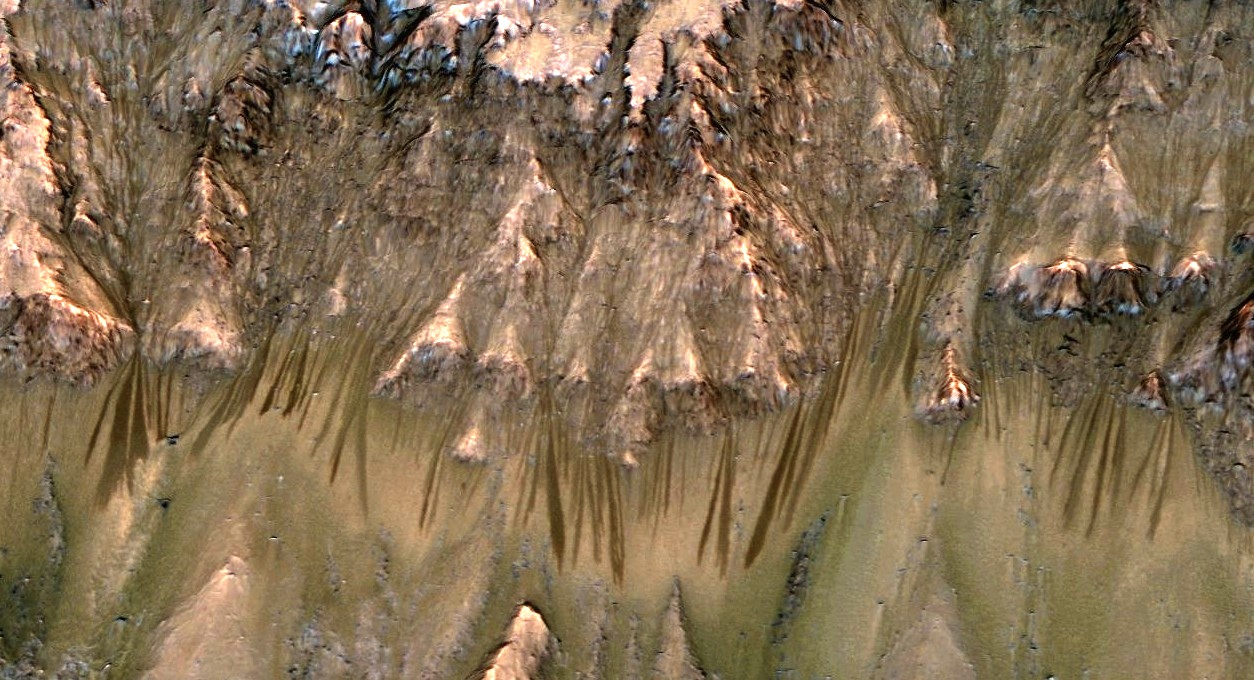
SALTY FLOWS? Dark streaks extend downslope from rocky areas or outcrops of bedrock and run for hundreds of meters (yards). These range in width from half a meter to about 5 meters, and are likely caused by flows of water loaded with salty "antifreeze." (Credit: NASA/JPL-Caltech/UAriz)

These are dark finger-like lines on steep slopes that appear during the warmest time of year. They are most likely caused by flows of salty water.

In a paper published in the journal Science (August 5, 2011), Alfred McEwen (University of Arizona) and colleagues describe “recurring slope lineae” (or RSLs for short). These lineaments occur in the middle southern latitudes on slopes facing the equator and which are steeper than 25°. They appear and grow incrementally during southern spring and summer, then fade and disappear over the winter. HiRISE has imaged them recurring in the same places for several Martian years.

Pure water can’t survive at the Martian surface today (let alone flow), but brines are a different story. Laden with salts, they can remain liquid at temperatures well below the point where pure water freezes. Data from THEMIS shows that the ground temperature on the slopes varies from about –23° to +27° Celsius (–10° to +80° Fahrenheit). Although no direct relation is known, the seasonal lineations occur in the same latitude band as sites where chloride minerals have been found.

The newly discovered lineations appear wholly different from the well-known dark streaks that appear on some slopes. The latter occur only in dusty areas and show no seasonal activity; they are thought to be dust avalanches. In contrast, the dark lineations are narrower, darker, appear and disappear seasonally, and recur from year to year in the same places.

The scientists acknowledge that how the darkening process works and the brine’s source remain unknown. In addition, the CRISM instrument on MRO should have detected spectroscopic evidence of water, but it did not.

“It’s a mystery now,” says lead scientist McEwen. “But I think it’s a solvable mystery with further observations and laboratory experiments.

Posted in Reports | Tagged , , , , , , , | Comments Off

South polar CO2 ice could double Mars’ atmosphere

Results from the Shallow Radar (SHARAD) instrument on NASA’s Mars Reconnaissance Orbiter show that the south polar layered deposits on Mars hold about 30 times as much carbon dioxide ice as previously known. If this CO2 were released into the atmosphere, the researchers say, it could nearly double the quantity of the gas in the air and similarly increase the surface pressure.

SLICE OF ICE: SHARAD draws a profile across the southern polar layered deposits, revealing layers largely free of dust and other materials that cause radar reflections. These clear lenses and volumes are likely to be CO2 ice. (NASA/JPL image)

A team of scientists led by Roger Phillips (Southwest Research Insitutute, Boulder) reports in Science that ground-penetrating radar profiles of the south polar layered deposits using SHARAD have revealed thick deposits of CO2 ice in the form of buried lenses and pockets. These are several hundred meters (roughly 1,000 feet) thick. Moreover, the team says, the ice occurs within a stratigraphic layer that shows collapse features perhaps caused by CO2 escaping from beneath the surface in the past.

In the current climatic cycle for Mars, where its axis tilts at 25° to the planet’s orbit around the Sun, the polar regions are cold. However, because it lacks Earth’s large stabilizing Moon, Mars can change its axial tilt (obliquity), reaching angles of 35° and more. During such high-obliquity periods — for example, one which occured about 600,000 years ago — the poles become much warmer than they are today, while equatorial regions become the coldest places on the planet. The polar warmth causes volatile materials, such as water and especially CO2 ice, to come out of the ground and go into the atmosphere.

Once in the atmosphere, the volatiles migrate to the colder parts of Mars, condense out of the air, and become trapped at the surface, thus depositing ice near the equator. Then, when the obliquity swings back and the climate pendulum follows in step, the volatiles reverse the migration, leaving the equator and returning to the polar regions by way of the atmosphere.

The team says, “If released into the atmosphere at times of high obliquity, the CO2 reservoir would increase the atmospheric mass by up to 80 percent.” They add that this would lead to “more frequent and intense dust storms and to more regions where liquid water could persist at the surface without boiling.”

Posted in Reports | Tagged , , , , , , | Comments Off

Mars in the Mojave?

Where do you go to order up some Mars on Earth? Several places, actually, such as the Atacama Desert in Peru (which is very dry), the Dry Valleys of Antarctica (dry and cold), and Houghton Island in Canada’s high arctic (cold).

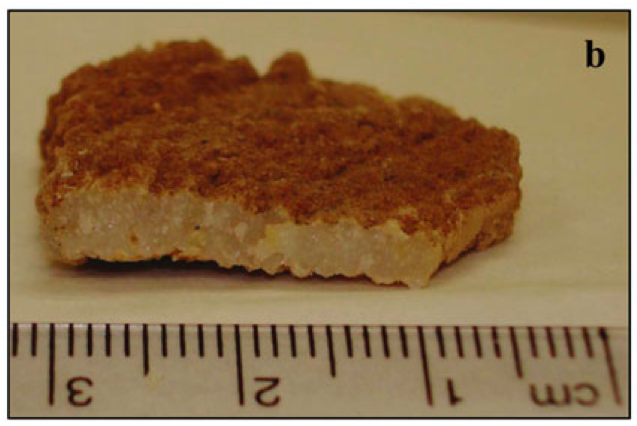
UPPER CRUST. A coating of the common rust mineral hematite effectively covers underlying carbonate rock in a sample from the Mojave Desert in California. A similar process may be hiding carbonate rocks from scientists on Mars. (Image taken from figure 3 in the paper.)

If Janice Bishop (SETI Institute and NASA Ames Research Center) and colleagues are right, perhaps scientists should add California’s Mojave Desert. Here the lure is mineralogy.

According to a paper published in the International Journal of Astrobiology, Bishop and her colleagues argue that traces of water and carbonate minerals could lie beneath the surficial iron oxide (rust) that covers rocks on Mars. This, they say, would be similar to desert varnish found on carbonate rocks in terrestrial deserts, especially the Mojave.

“The plausibility of life on Mars depends on whether liquid water dotted its landscape for thousands or millions of years,” says Bishop. “It’s possible that an important clue, the presence of carbonate minerals, has largely escaped the notice of investigators trying to learn if liquid water once pooled on the Red Planet.”

Individual small exposures of carbonate minerals have been found on Mars, but perhaps they aren’t so much rare as well concealed, the scientists say.

Members of the team explored an area in the Mojave called Little Red Hill, which receives about 10 centimeters (4 inches) of rain a year. After the field scientists collected carbonate rocks coated with iron oxides and aluminum-rich clays, the scientists back in the lab found that the surface layer largely masked the spectral fingerprints of carbonate minerals from remote-sensing instruments.

They write, “Our study of iron-rich coatings on carbonate rocks from the Mojave Desert indicates that rock coatings contribute to the challenge of detecting carbonates from orbit.”

Also, on some terrestrial rocks, the team found blue-green algae under the surface varnish, where it was protected from dehydration. If a similar process operated on Mars, it could have extended the time Mars was habitable. Moreover, the coating protects terrestrial microorganisms by shielding them from ultraviolet light – and the same effect could operate on Mars with any hypothetical Martian microorganisms.

Posted in Reports | Tagged , , , , | Comments Off

Commemorating Mars Exploration Rover Spirit

The cast and crew of scientists and engineers who designed, built, and operated the Mars rover Spirit for its 2,210 days in Gusev Crater held a commemoration and celebration for the rover at its birthplace, the Jet Propulsion Laboratory, on July 19, 2011. Speakers included NASA associate administrator Ed Weiler, rover project manager Pete Theisinger, rover scientist Steve Squyres, and many more rover scientists and engineers.

FAVORITE PICTURE: "Eighteen days into Spirit's mission, we appeared to have lost the vehicle," says Steve Squyres. "She just went silent. We didn't know what was going on — it was absolutely terrifying. It turned out to be a software problem, which was solved by brilliant analytical work by the team. This was the first picture that came down, on sol 25, after the problem was fixed. It showed us we had a healthy spacecraft ready to start exploring the surface of Mars." (NASA/JPL/Cornell image)

Showcased highlights of the mission include:

  • The software error 18 days after landing that nearly killed Spirit
  • Scientists’ realization that the Columbia Hills would be better hunting grounds than the all-volcanic floor of Gusev
  • Observing dust devils in action
  • The mountaineering climb to the top of Husband Hill
  • The discovery of carbonate rocks in the Columbia Hills
  • The discovery of nearly pure silica in ancient hot springs or a fumarole at Home Plate

As rover engineers and scientists reminisce about the mission, you can peek over their shoulders to see how the project came together through “three and half years of terror and tension,” as Squyres describes it, followed by six years of highly successful operations on Mars. (Not bad for a 90-day mission.)

You also hear how potentially showstopping problems were solved, like using jigsaw-puzzle techniques to get enough cells onto the solar panels to provide adequate power. Without these the instruments would have been perpetually starved for juice.

And then there was the time a small metal washer was accidently dropped into the intricately folded airbags used to land the rover safely. That tiny washer had to be retrieved — and the key to finding it was dropping five more washers in the same place….

The streaming video runs 80 minutes, but it’ll seem a lot shorter.

Posted in Reports | Tagged , , , , , , | Comments Off

Will Opportunity find dunes on the move?

Mars Exploration Rover Opportunity is driving toward the rim of Endeavour Crater on Meridiani Planum. Twenty-two kilometers (14 miles) wide, Endeavour is largely obliterated, with only about half its rim remaining as low hills rising above the plain. The crater’s generally smooth floor slopes down to the south, making a broad basin about 300 meters (1,000 ft) below the plains. In this low spot, dunes made of dark basaltic sand lie in domes, sheets, crescents (called barchans), and ridges that wander like pieces of yarn.

dunes in Endeavour Crater

IT'S A BREEZE. Winds from the northwest sculpt dark sand dunes in Endeavour Crater. This false-color image combines a mosaic from the Context Camera (CTX) and nighttime temperatures from the Thermal Emission Imaging System (THEMIS). Cooler colors indicate smaller sand grains. The white areas with Roman numerals are dunes that changed shape between 2001 and 2009. (Figure 5 from the paper.)

According to a new paper in the Journal of Geophysical Research, Opportunity may see these dunes in action after it arrives at the rim in August 2011. The paper’s lead author is Matthew Chojnacki (University of Tennessee).

Using images taken from orbit between 2001 and 2009, the team found that some dunes migrated, two dunes shifted by 10 to 20 meters (33 to 66 ft), two other dunes disappeared entirely, and all the dunes appear to have lost sand to erosion by the wind. The conclusion seems clear: these dunes are active now.

The dunes’ shapes show that winds in the basin blow from the northwest, the direction from which Opportunity is approaching. Actual wind speeds are unknown, but by determining sand grain sizes (about half a millimeter and smaller), scientists estimate that wind velocities of around 3 meters per second (7 miles/hr) could get sand moving.

As it happens, however, by the time Opportunity can see directly into the basin, the season of strongest winds — southern spring into summer — will be coming to an end. But the timing won’t matter much because the rover will be studying rim deposits for many months to come, and any dune investigations would have to wait anyway.

Looking ahead, however, the authors say, “If Opportunity spends as much time at Endeavour Crater as it spent at Victoria Crater (more than one Mars year), the rover could detect the removal of additional dunes.” They add that if Opportunity remains healthy, “an attractive long-term drive target might be to the vicinity of these changing dunes.” That would let scientists see Mars sand dunes in action close-up for the first time.

Posted in Reports | Tagged , , , , | Comments Off

Meteorites: Keys to bygone Mars climates

The sky falls on Mars, too, just as it does sometimes on Earth. In its long crosscountry drive over the pool table expanse of Meridiani Planum, Mars Exploration Rover Opportunity has encountered more than a dozen meteorites, all of them iron or stony-iron in composition.

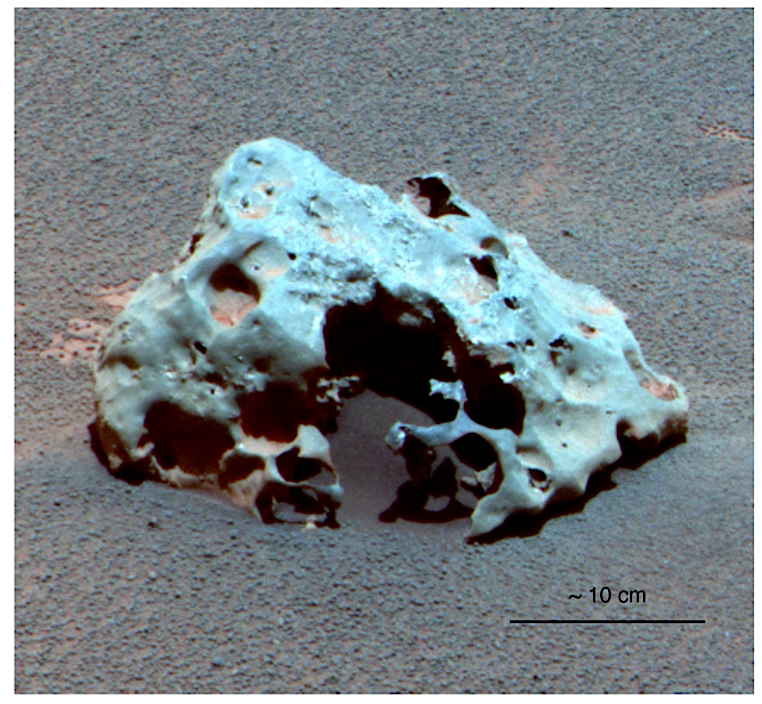
ALL HOLLOWS. Weathering has reduced the iron meteorite Mackinac Island (about a foot in diameter) to a filagreed shell, suggesting that the iron originally contained many sulfur impurities. These corroded and weathered away as climatic cycles repeatedly exposed the meteorite to acidic water or ice. (Figure 6b from the paper.)

Meteorites found on Mars are curiosities, but they can be something more than that, as a recent paper in the Journal of Geophysical Research points out. A team of scientists led by James Ashley (Arizona State University) notes that because we have samples on Earth of the same kinds of meteorites found there, scientists can use the weathering seen on the Martian examples to probe bygone Martian climates.

The paper details three of Opportunity’s Mars meteorites, dubbed Block Island, Shelter Island, and Mackinac Island. Block Island was found by Opportunity on sol (Mars day) 1961 (July 31, 2009), Shelter Island on sol 2022 (October 1, 2009), and Mackinac Island on sol 2034 (October 14, 2009).

What’s most distinctive about these meteorites is that they show evidence for repeated episodes of weathering. For example, Block Island (an iron meteorite) shows two dramatically different faces: one smoothed, probably by sandblasting, and the other deeply pitted, probably by acidic corrosion. The corrosion likely occurred as thin films of water encountered iron sulfide minerals commonly found in iron meteorites.

Both Block Island and Shelter Island show evidence for multi-stage weathering. Close examination of their surfaces show that both have lost through weathering the fusion crusts that meteorites commonly develop as they speed through the atmosphere. Then exposure to water (or probably ice) created an oxydized (rusted) outer layer. This in turn has been largely scoured away by wind erosion.

There’s no way at present to determine how long those meteorites rested on the surface before Opportunity rolled by. But the weathering is unlikely to have happened recently, given Mars’ current arid, cold climate. Yet scientists know that over the last half million years at least, the planet’s spin axis has changed its tilt with respect to the Martian orbit. This has produced periods when snow and ice have come down from the polar regions and accumulated near the equator, probably including Meridiani Planum.

While the meteorite hunting has been good on the drive — it doesn’t take much for a rock to stand out on Meridiani’s barren plains — the harvest is likely to start winding down. Soon Opportunity will be at Spirit Point on the Cape York ridge, the closest section of Endeavour Crater’s rim. Once it arrives, Opportunity’s science mission will shift focus to studying the rocks and outcrops found there. While more meteorites will surely turn up, they are likely to be fewer in number than up to now.

Posted in Reports | Tagged , , , , , , , , , | Comments Off