Jarosite: key to ancient temperatures?

The water-related mineral jarosite is occurs both on Earth and in sediments on Meridiani Planum, Mars. Scientists have found that by measuring the isotope ratio of argon-40 to argon-39 in the rock — a technique that can be applied to rock samples brought from Mars — they can tell how long ago it felt the touch of water and also, with a few assumptions, how warm the water was.

“Our results suggest that 4 billion-year-old jarosite will preserve its argon and, along with it, a record of the climate conditions that existed at the time it formed,” says Suzanne Baldwin (Syracuse University), one of the authors of the study, published October 15 in Earth and Planetary Science Letters.

Posted in Reports | Tagged , , , , , , | Comments Off

Did lake-effect storms make Martian snowbelts?

Numerous places on Mars show erosion by precipitation, whether as rainfall or runoff from melting snow. The precipitation could have come from a thicker atmosphere or a temporary boost in atmospheric temperature and density following a large impact. Both scenarios would generate global precipitation effects.

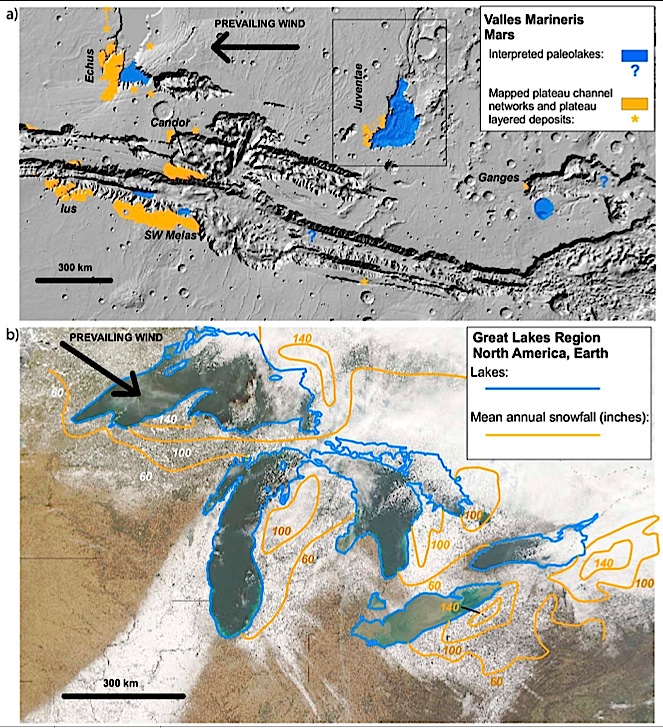
LAKE EFFECT SNOWSTORMS. Transient lakes on Mars should have generated snowbelts like those that lie downwind of the Great Lakes in North America. (Image is Figure 1 from the paper.)

But looking toward more local scales, a group of researchers led by Edwin Kite (University of California, Berkeley) studied what happens after an outburst of water produces a transient lake in a small area, such as a chaos region. These are places where large amounts of subsurface water burst out through cracks in the ground, then flow away or evaporate.

Focusing largely on Juventae Chasma and Echus Chasma near Valles Marineris, they write in the Journal of Geophysical Research (October 11, 2011), “Local precipitation is an attractive explanation for the 3-billion-year-old valleys in layered deposits on the plateaus around Valles Marineris.” These channels, the researchers explain, “Formed after the sharp decline in global erosion rates and channel formation around 3.7 billion years ago.”

Using current models for atmospheric circulation and behavior, they calculate that in the case of a lake in Juventae, rapid updrafts would carry water vapor about 35 kilometers (22 miles) high.

“More than 80 percent of the vapor released by the lake is trapped in or next to the lake as snow,” they explain. Snow that did not fall back into the lake drifted southwest on prevailing winds to collect on the plateau next to Juventae. The runoff as the snow melted then carved valleys in the plateau deposits.

The team acknowledges that an atmospheric state like the present could not melt the snow given the Sun’s fainter luminance 3 billion years ago. “To erode channels from snowmelt,” they say, “requires a change in background atmospheric state, or transient heating from impact ejecta, or geothermal activity. Without transient heating, either the atmospheric pressure would need to be at least 10 times greater or have extra greenhouse warming (or both).”

They conclude, “Our model strongly predicts that plateau channel networks will not be found more than 250 km from a surface water vapor source.” Moreover, they add, “It also predicts that additional plateau channel networks and layered deposits should be identified downwind of large, localized vapor sources elsewhere on Mars.”

Posted in Reports | Tagged , , , , , , , , , | Comments Off

Dry ice glaciers?

Scientists examining rocky remnants in Mars’ northern polar region believe they have found evidence for a type of glacier unknown on Earth – one where the ice is made of frozen carbon dioxide rather than water.

ICY FINGERPRINTS. Narrow ridges of debris mark the farthest extent of unusual glaciers in the Martian arctic. From clues in their location, apparent age, and geological details, scientists think these ridges were left by glaciers made of carbon dioxide ice, a kind of glacier unknown on Earth. (Image is Figure 1b from the paper.)

Mikhail Kreslavsky (University of California, Santa Cruz) and James Head (Brown University) write in Icarus about finding sets of overlapping ridges in three locations in the Martian high arctic. They interpret these as drop-moraines: ridges of accumulated dust and debris left by glaciers whose bottom layer was frozen to the ground.

Considering the ridges’ location and past climate regimes on Mars, Kreslavsky and Head conclude that the most likely material for the glacier was CO2 ice, not water ice.

A dry-ice glacier would behave differently from a water ice one, they explain. At temperatures cold enough to keep both CO2 and water frozen, CO2 ice is softer and more plastic, and it tends to flow farther and more quickly. One outcome of these qualities is that CO2 glaciers would be prone to develop finger-like lobes to a much greater extent than a water-ice glacier. This fits the shape, size, and outline of the ridges.

A cold-based glacier has its bottom layer frozen to the surface; such glaciers do not slide across the ground, plowing up rocks and debris, as does a typical water-ice glacier on Earth. Instead, its leading edge would advance by rolling over the ground much the way that a tongue of cake batter flows into a pan.

When the glacier reaches its greatest extent – where the ice melts (or sublimates) as fast as it flows – the ice flow will continue within the glacier but won’t advance its snout. This internal conveyor belt carries forward debris accumulating on the glacier, and dumps it at the snout, building the ridge as a drop-moraine.

How long ago was the glacier active? Today’s climate on Mars would destroy a CO2 glacier in the same location. But cyclical changes in the tilt of the Martian axis can produce both warmer and colder climates in polar areas. Calculations of the tilts in past eras lead the scientists to narrow down when a CO2 glacier might have formed and been active.

As they explain, “The climate projections provide a rather certain age estimate of 600,000 to 800,000 years for the youngest glacier, and the oldest may be as old as 3.4 million years — but it also could be about 1 million years old.”

Posted in Reports | Tagged , , | Comments Off

Can melting snow make small holes in Mars rocks?

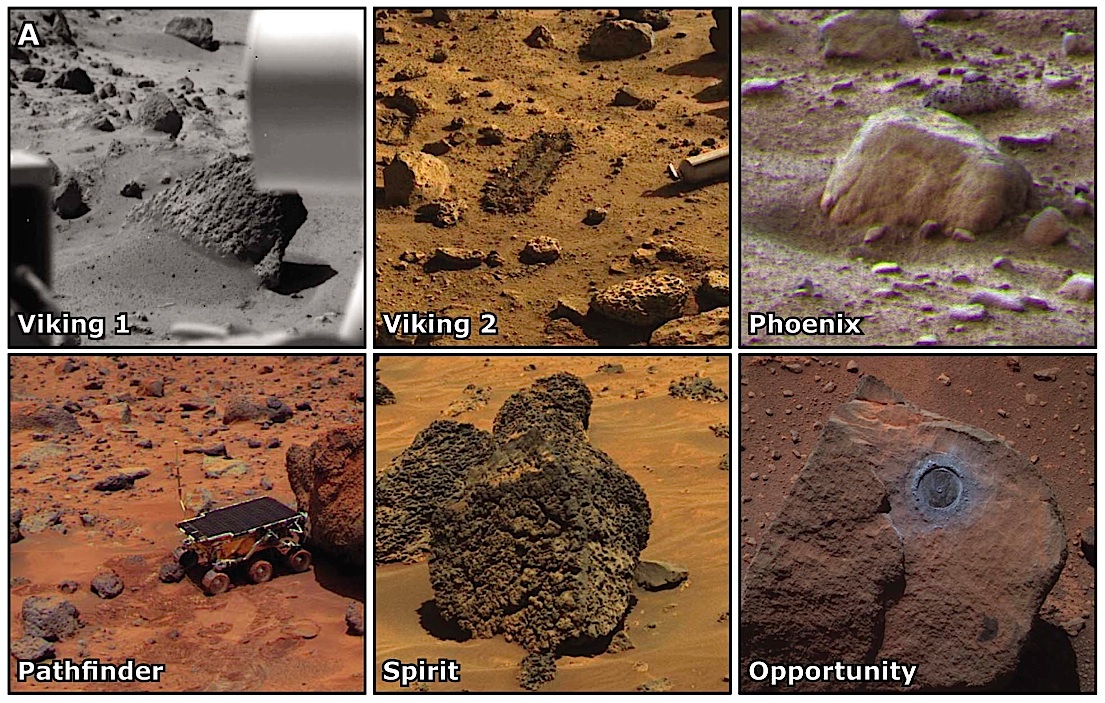
Many rocks on the surface of Mars show pits and small holes. One way such pits can form is when gas-rich lava erupts; the pits, called “vesicles,” form when gas escapes from the lava as it’s cooling. Wind-driven sand can also dig pits and flutes in rocks, as can the removal of individual mineral crystals, and salt crystals can also force open holes in rocks as they grow.

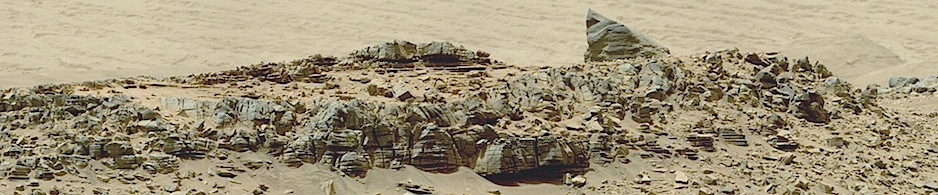
WHAT MADE THESE PITS? According to a new paper, weathering can occur on Mars when frost or snow collects in surface rough spots, melts, and then attacks the rock's minerals. (Image is Figure 1a from the paper.)

A group of planetary geologists led by James Head (Brown University) report on the Martian applicability of a different pit-making method: weathering by melting snow.

Writing in the Journal of Geophysical Research (September 17, 2011), they say that igneous rocks in the Antarctic Dry Valleys – the place on Earth most like Mars – form pits where snow collects. Warmed by sunlight, the snow melts, becoming liquid for a short time during which the water can chemically attack the rock and deepen the pit.

How does this model apply to Mars? The scientists say that for this kind of weathering to occur on Mars, (1) atmospheric pressure has to be high enough (612 pascals) to permit liquid water (at least briefly), (2) rock surface temperatures have to rise above 0° C (32° F), and (3) there has to be snow or frost available for melting.

Taking these requirements one by one, they say that Mars currently has an atmospheric pressure above 612 Pa at each of the six landing sites (Vikings 1 and 2, Mars Pathfinder, Mars Phoenix, and both Mars Exploration Rovers) during at least part of the year. In the past, they explain, the atmosphere was likely thicker.

Mars soils, they note, definitely become hotter than 0° C in many places, but heating rocks is harder. Nonetheless, during seasons when Mars is near perihelion (closest to the Sun), sunlit rock faces often heat up 2° to 5° C warmer than freezing.

Finally, the researchers say that frost and snow are quite rare, but occur in small amounts at high latitudes. Snow, they note, was seen falling from clouds by the Phoenix lander, although it did not reach the ground. But if conditions became only slightly more favorable, they say, frost or snow might be a source of water by accumulating in pits and surface irregularities on rocks.

“We find that on Mars today,” the researchers write, “each of the conditions required for melting snow and ice on rock surfaces are met locally and regionally, but the conditions are very unlikely to occur together to produce the type of melting that forms pits in the Antarctic Dry Valley environment.”

However, they conclude, “the combination of conditions favoring this process are highly likely to have been met repeatedly in the geological past.”
Posted in Reports | Tagged , , , , , | Comments Off

Seeing Mars on the fly

Mars has as much surface territory as all the land areas of Earth, and scientists have barely touched the planet at ground level, despite 35 years of lander and rover missions.

So maybe it’s time to send a hopper.

HOT GAS MAKES IT GO. The proposed "Mars hopper" scavenges carbon dioxide gas from the atmosphere, heats it, and uses the hot gas to jet the lander roughly a kilometer each time. With landing legs extended, the diameter is 4 meters, or 13 feet. (Image is Figure 1 from the paper.)

Hugo Williams and colleagues at the University of Leicester, working with Astrium Ltd. in the UK, the Centre for Space Nuclear Research in Idaho, and Oregon State University are proposing a new Mars Reconnaissance Lander vehicle expressly designed to cover a lot of ground — 200 kilometers (120 miles) or so — during a basic mission lasting four Earth years. Unlike slow-rolling rovers, the MRL would take kilometer-long jumps between points of interest. The spacecraft is described in a paper published August 3, 2011, in Planetary and Space Science.

As outlined, the Mars hopper would carry a small (16.5 kilogram, 36 pound) science payload, modeled after that carried by the Beagle 2 lander. (This is about the same as the science payload on each Mars Exploration Rover.) Instruments would include a stereo camera, a gas chromatograph mass-spectrometer, and a Mössbauer spectrometer. The hopper would spend at least a week at each landing site, studying the area while reloading its fuel supply.

The hopping power comes from a thruster that fires carbon-dioxide gas collected from the atmosphere by an air pump through a bed of pebbles preheated by a radioisotope.
(Cold gas would also work, but provide less thrust and a shorter hopping range.) The electrical power comes from a radioisotope Stirling-cycle generator.

Concepts for hopping vehicles have been proposed before, but this time the predicted vehicle performance is matched to a hypothetical mission traverse through an area along Hypanis Vallis. The region in question lies at the edge of the ancient highlands and includes one of the proposed landing sites for the Mars Science Laboratory.

Posted in Reports | Tagged | Comments Off

Making fans all over

Water and sediment run downhill, on Earth and Mars alike. And when they do, they build broad alluvial (outwash) fans at the foot of slopes. But how fast do these fans accumulate? On Mars, at least, it looks like they grow very slowly indeed, probably over tens to hundreds of millions of years.

OUTWASH. By modeling how fast the alluvial fans in craters (such as Holden) can form, scientists can put boundaries on past Martian climates. These models point toward either a brief "humid pulse" of erosion - or timescales measured in tens to hundreds of million of years. (Image taken from Figure 3 in the paper.)

Studying dozens of sedimentary fans within ancient craters, a group of geologists led by John J. Armitage and Nicholas H. Warner (Imperial College London) describe in Geophysical Research Letters (September 9, 2011) their models for creating fans on Mars using water runoff from rain and melting snowfall. “Our objective,” they explain, “is to constrain likely scenarios for making large, low-gradient fans under different conditions of precipitation and time.”

What they found is that the amount of rainfall (or equivalent snowmelt) typical of arid climates on Earth needs million-year timescales at least to make a large alluvial fan on Mars. Under hyperarid climates (meaning roughly millimeter or so of rain per year), it takes 100 million years or more to develop a Martian fan.

And turning the problem around to focus on precipitation, they find that to do the job in only a million years, Mars wouild need a rainfall equivalent to a temperature climate on Earth, with more than 20 centimeters (or 8 inches) a year.

These timescales, they note in passing, are in “stark disagreement” with earlier models of alluvial fan development.

Looking at Holden Crater, whose interior contains several merged fans — including a candidate landing site for Mars Science Laboratory — the scientists’ model suggests that under semiarid conditions, it would take 1 to 3 million years to form; under more arid conditions, the necessary time grows sharply to 20 to 60 million years.

Finally, the team suggests that Martian alluvial fans imply either a “humid pulse” of weathering that lasted roughly a million years, or that Mars experienced a persistent arid climate that extended 10 million to 100 million years.

Posted in Reports | Tagged , , , | Comments Off

NASA’s long road to Gale Crater

If Gale Crater isn’t your favorite choice for a landing site for NASA’s next Mars rover, you can’t claim the choice was made hastily. The international community of Mars scientists thoroughly sifted the Red Planet to find a feasible landing site for the Mars Science Laboratory (MSL) rover, dubbed Curiosity. It is due to launch in late November 2011 and will arrive at Gale Crater in August 2012.

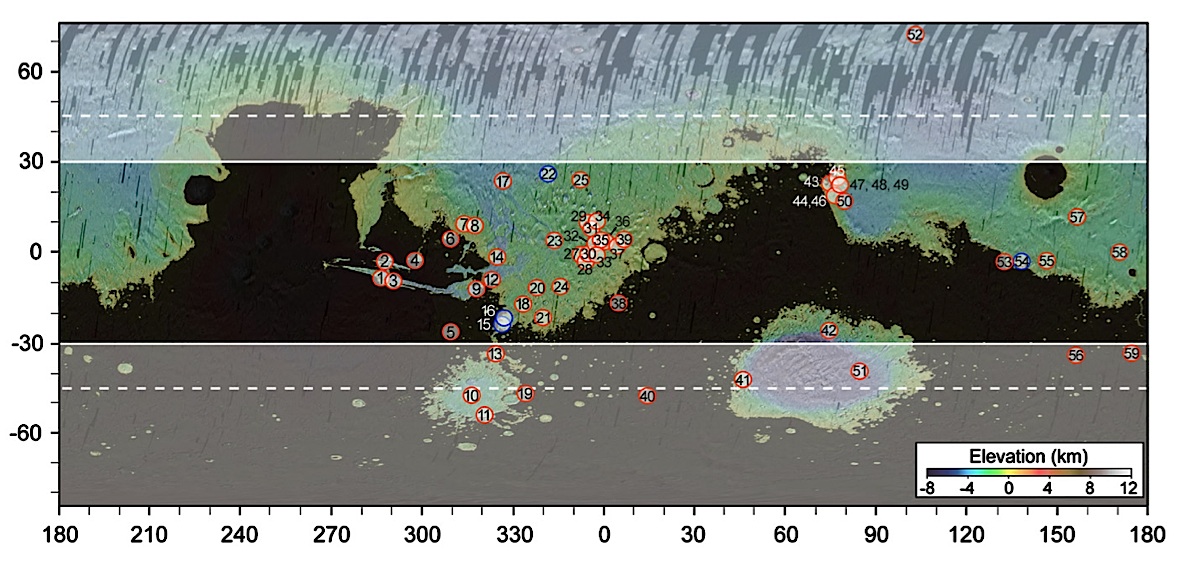
OUT OF MANY, ONE. All the 59 sites considered as landing places for the Mars Science Laboratory appear on this Mars map. Initially, the band from 45° N to 45° S (dotted white lines) was considered safe and feasible from the engineering viewpoint. These bounds were later narrowed to 30° N and S (solid white lines). The Final Four candidates are in blue; the winner - Gale Crater - is number 54, located toward the right edge. (Figure 3 from the paper.)

MSL’s mission is to look for a geologic environment (or set of environments) that would support microbial life, past or present, and which could be assessed by the rover’s instruments. Scientists held five workshops between 2006 and 2011 to identify potential sites — a search that turned up a total of 59 individual landing sites, each of which was examined carefully.

The process of how scientists converged on a small group of suitable sites is described in a recent paper in Planetary and Space Science by John Grant (National Air and Space Museum) and colleagues. Grant headed the search effort along with the Jet Propulsion Laboratory’s Matt Golombek, also a co-author on the paper.

While engineering constraints, plus snags in technology development, imposed latitude and altitude limits for potential sites, in the end all of the Final Four sites (Eberswalde Crater delta, Gale Crater, Holden Crater, and Mawrth Vallis site 2) came out equal from an engineering perspective. It was science that drove the choice.

At the first workshop, 35 sites were proposed, debated, and ranked. The second tackled 50 sites (many of them new), and came up with a short list of six. A seventh site was added at the third workshop, from which emerged the Final Four. The last two workshops sharpened the picture of these sites, using new data from Mars Odyssey, Mars Reconnaissance Orbiter, and Mars Express. (The fifth workshop, in May 2011, had not yet occurred when the paper was completed.)

To leave NASA and the MSL project with a free hand to choose among the candidates, the last workshop reviewed all the data and summed up the pros, cons, and uncertainties of each site — but deliberately made no recommendation. About a month later, on June 24 NASA announced that the four sites had been narrowed to two (Gale and Eberswalde), and on July 22, the space agency announced the final choice of Gale as the landing site for the Mars Science Laboratory.

It should be a spectacular place to explore.

Posted in Reports | Tagged , , , , , , | Comments Off

Water-related minerals in Noctis Labyrinthus

Noctis Labyrinthus, created 2 to 3 billion years ago, is a sprawling network of intersecting valleys and troughs between the Tharsis volcanic highlands and Valles Marineris. Deep within its troughs, canyon walls and floors display beds of layered rocks and deposits of water-altered minerals.

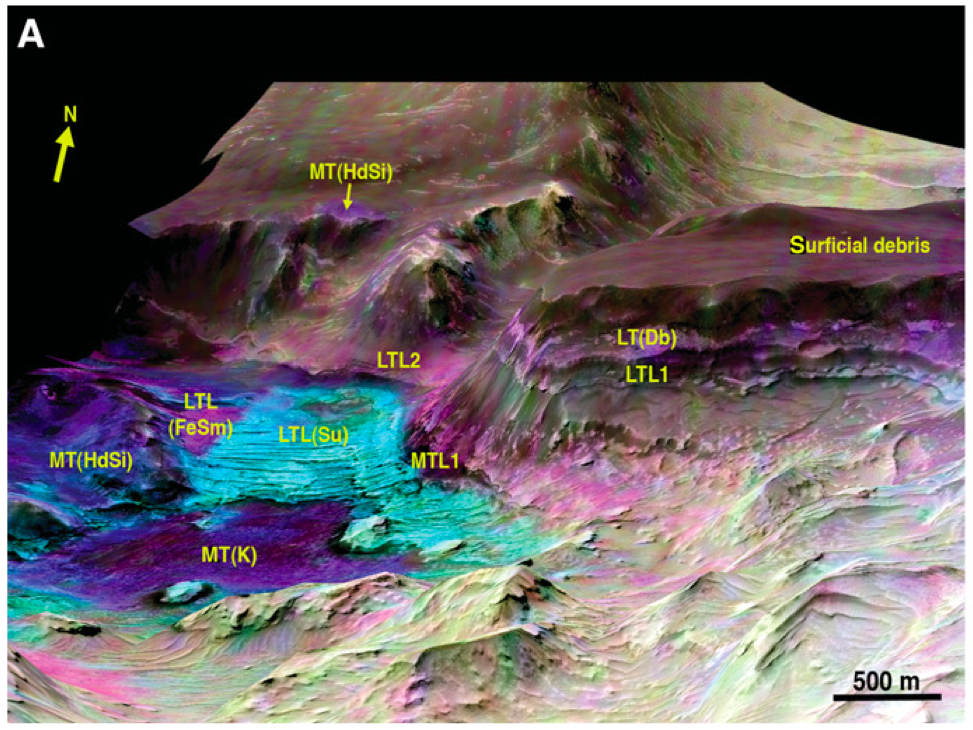
COLORFUL CLAYS. Data from the CRISM spectrometer on the Mars Reconnaissance Orbiter, as converted into false colors, combined with topography and morphology derived from the HiRISE camera, maps numerous deposits of hydrated minerals deep in a trough where valleys intersect in Noctis Labyrinthus. The mineralogy suggests that the older deposits formed under acidic conditions, while later ones are chemically neutral - inverting the generally accepted scheme for Mars' chemical evolution. (Image taken from Figure 2a in the paper.)

Two small troughs within Noctis, however, contain a richer assortment of these water-related minerals than almost any place else on Mars. Writing in Geology (September 2), Catherine Weitz (Planetary Science Institute) and colleagues map and identify 11 individual geologic units in one of the locations, and 13 in the other.

The scientists report, “The diverse minerals in these two troughs indicate many events involving water and deposition that occured over a long time.” Geologic features within the deposits also indicate that the minerals were laid down while the Noctis canyon system was still growing.

Groundwater, hydrothermal activity, and melting snow/ice are all plausible sources for the water that created these minerals. “We found no channels or other fluvial features along the adjacent plateau,” the team notes, ruling out surface flows of water into either trough.

More intriguing is the global chemical evolution implied by the nature of the hydrated minerals. A widely held view among scientists is that early Mars was chemically neutral producing clays and then it evolved through volcanic activity toward a generally acidic environment that formed sulfates.

In a reversal, the team found the older layers in one trough formed under acidic conditions, while later deposits were neutral. In the other trough, the mineral deposits went from neutral to acidic and then back to neutral.

The team notes, “The observations indicate that the troughs underwent localized aqueous conditions that were inverted relative to the global chemistry of Mars.”

That has interesting implications for life, they explain. “These places were potentially habitable zones for life 2 to 2.5 billion years ago, when drier conditions dominated the surface.”

Posted in Reports | Tagged , , , , , , | 2 Comments

Devilry in the air

With all the spacecraft orbiting Mars, it’s slightly surprising that there aren’t more observations of dust devils shared by two or more instruments.

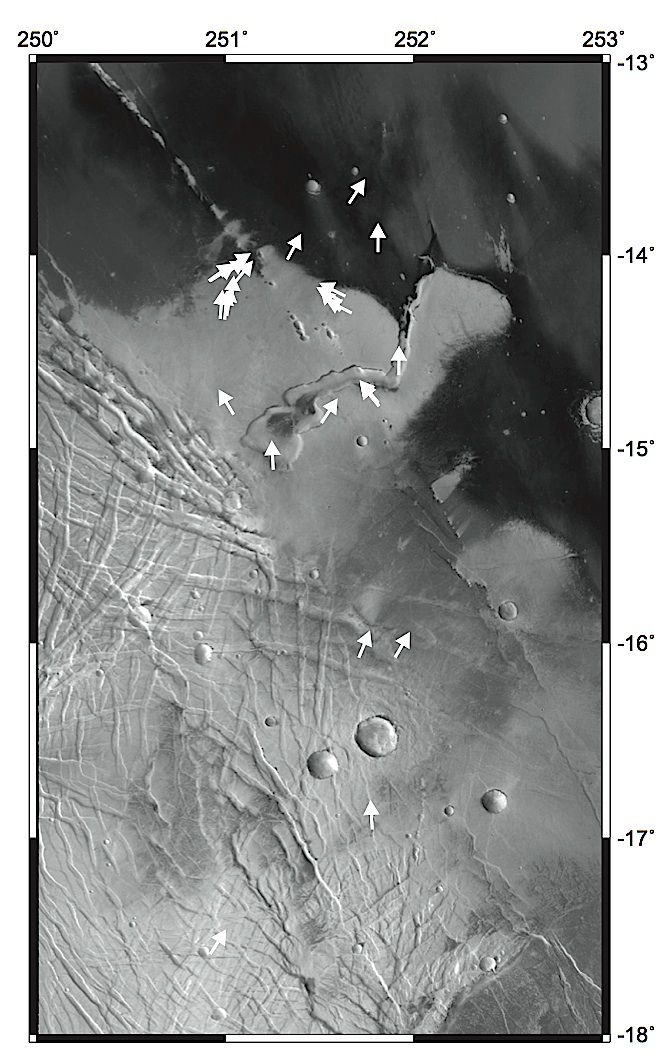
ON THE MOVE. White arrows indicate where dust devils were photographed nearly simultaneously in Syria-Claritas by the MOC-WA camera and HRSC. The arrows point in the direction the dust devils were moving. (Taken from Figure 4 in the paper.)

Writing in the September 2011 issue of Icarus, a team of scientists led by Dennis Reiss (Westfälische Wilhelms-Universität, Germany) describes 11 dust devils that were observed by coincidence on the same day (September 11, 2005) some 26 minutes apart by both the MOC-Wide Angle camera on Mars Global Surveyor and the High Resolution Stereo Camera on Mars Express. The region where they were seen is Syria Planum-Claritas Fossae, an area known for its bright dusty surface.

The near-simultaneous observations with two image channels of HRSC (about 1 minute apart) let the team measure the speed and direction of movement for
the whirlwinds. The local time on Mars was about 1:45 p.m. and the season was early southern summer.

The MOC image was taken first, followed by the HRSC image. The team says, “It’s very probable that some of the dust devils observed in the MOC-WA image broke up before the HRSC image was made — and likely that some observed in the HRSC image formed after the MOC-WA image was taken.”

Despite this, the scientists were able to track one big dust devil seen in the HRSC image back to the MOC-WA image, where it showed a ground track already in progress. “For the largest dust devil, about 820 meters [2,700 feet] in diameter, it was possible to calculate a minimum lifetime of around 74 minutes, based on the measured horizontal speed and the length of its associated track in the MOC image,” say the researchers.

Previous studies of Martian dust devils attempted to estimate how much dust they lift into the air, but the calculations are difficult. Working with data from dust devils in Gusev Crater by the Spirit rover, the team suggests that their biggest dust devil (noted above) — roughly 1,500 meters (4,900 ft) tall and moving 10 meters/sec (22 miles/hr) — was carrying about 235 kilograms (520 pounds) of dust in suspension.

In regions with a lot of dust to pick up, the scientists say, big dust devils probably contribute most of the dustiness in the air, even though smaller dust devils are far more numerous.

They explain, “Large dust devils are able to lift dust to much higher atmospheric layers — greater than a kilometer — which causes much longer retention times in the atmosphere due to the slower dust settling rates.”

However, they add, “We also note that our estimates have several uncertainties due to rare observations and measurements of large dust devils on Earth and Mars.”

Posted in Reports | Tagged , , , , , , , , , | Comments Off

Down in the deltas

Although NASA passed over Eberswalde Crater to choose Gale Crater as the landing site for the Mars Science Laboratory (MSL), Eberswalde offers the best known example on Mars of a river delta built from sediment washed into a crater lake.


DELTAS SIX. While the large delta (1) in Eberswalde Crater is well known, researchers have identified at least five more deltas within the crater's western half. The black oval marks MSL's intended landing area. (Image taken from Figure 2a in the paper.)

A new study published August 27 in Geophysical Research Letters says that Eberswalde has not just the one known and well-studied delta, but at least five more located within the crater’s western half. The researchers, led by Melissa Rice (Cornell University), say that all six deltas share what appears to be the same sequence of three sedimentary beds.

In addition, the team identifies and traces fault lines and scarps trending north-northeast through the crater. These, they say, affected the large-scale structure of Eberswalde Crater, dividing it by means of a central high ground, which is flanked by faults, into eastern and western basins. The team also argues that these structures played a role in controlling how the deltas were built.

The researchers trace the faults all across Eberswalde, including the rim, so they believe the faulting came after the Eberswalde-making impact. Its source isn’t clear, but the team notes that the faults lie radial to the giant volcanic province of Tharsis. The stresses associated with building that enormous stack of lava might have produced faulting in the Eberswalde area, just as it did elsewhere.

The sedimentary sequence found in each of the deltas, identified using the HiRISE camera on Mars Reconnaissance Orbiter, has a layered unit on top, a fractured unit below that, and a pitted unit on the bottom. Between the fractured and pitted units is an erosional gap of unknown duration.

The researchers interpret the layered and fractured units as sediments produced by streams flowing into the Eberswalde lake, while the pitted unit is probably an ancient eroded surface, a sheet of impact melt, or debris ejected by the impact making nearby Holden Crater.

Because two of the proposed deltas (3 and 4) lie on top of the central high , the researchers say, “We suggest the lake in Eberswalde Crater must have covered the central high to a minimum depth of -1385 meters.” That level would cover all the deltas in addition to the central high, implying that the lake had once covered the entire crater floor.

Posted in Reports | Tagged , , , , , , | Comments Off