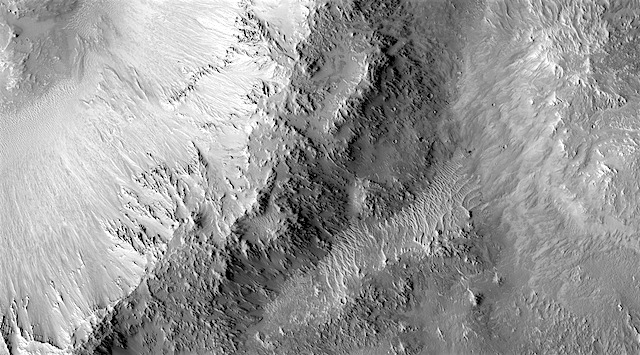
HiRISE: Weathered ejecta and pitted material associated with Kontum Crater

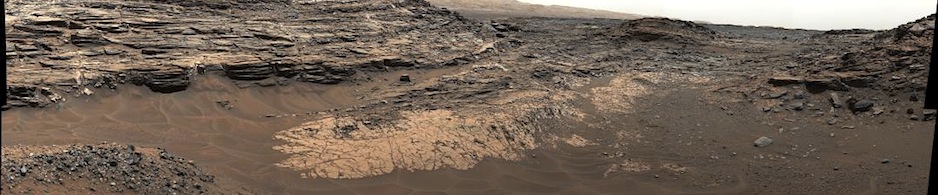
tumblr_p82bt3DXUq1rlz4gso1_1280Weathered ejecta and pitted material associated with Kontum Crater. Weathered, eroded, and scoured ejecta of Kontum Crater could expose ponded, pitted, and underlying material, as well as interesting contrasts. This image is right outside Kontum Crater on the eastern side.

Beautiful Mars series. [More at links]

Posted in Reports | Tagged , , , , , , , , , | Comments Off

THEMIS: Volcanic fissure in Labeatis Fossae

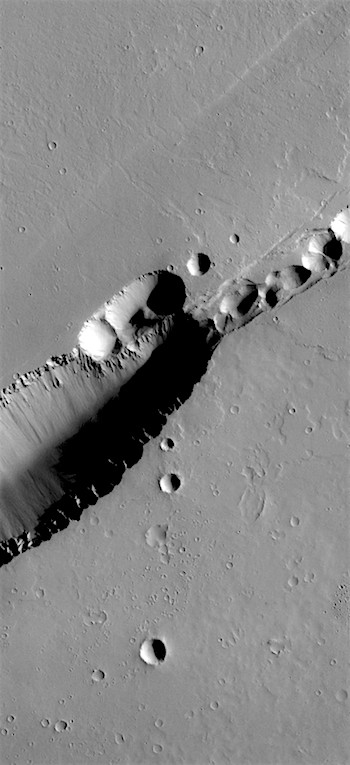
Volcanic fissure in Labeatis Fossae (THEMIS_IOTD_20180508)THEMIS Image of the Day, May 8, 2018. The feature that crosses this VIS image is a graben. Graben are formed by tectonic action, where a block of material moves downward between a pair of faults. The northern part of the Tharsis plateau is full of graben, most notably surrounding Alba Mons. The section of Labeatis Fossae seen in this image is directly south of Uranius Mons.

More THEMIS Images of the Day by geological topic.

Posted in Reports | Tagged , , , , , , , , , , , , , , | Comments Off

HiRISE: Eastern rim of Bonestell Crater

tumblr_p80h78UpIT1rlz4gso2_1280Eastern rim of Bonestell Crater. There are some excellent bedrock exposures in these images.

Beautiful Mars series. [More at links]

Posted in Reports | Tagged , , , , , , , , | Comments Off

Opportunity: Passage to Inde

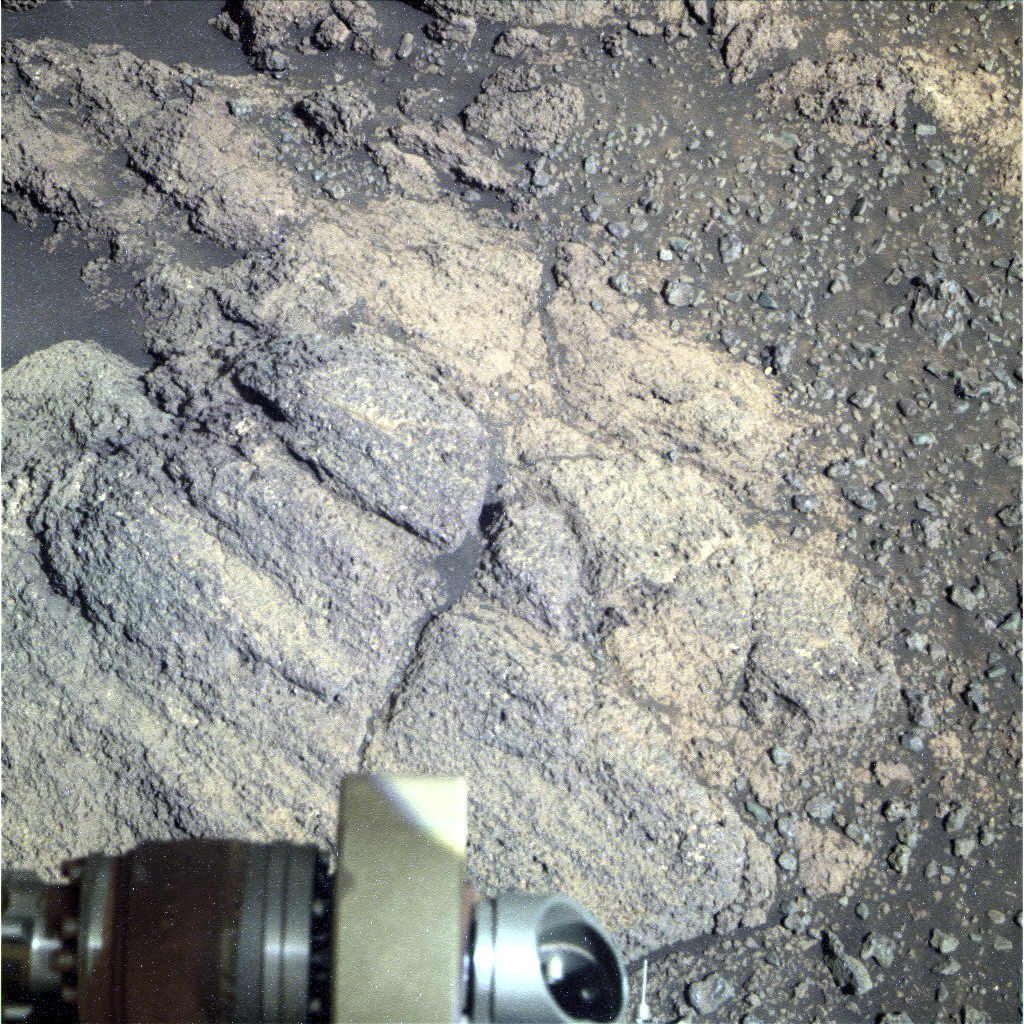
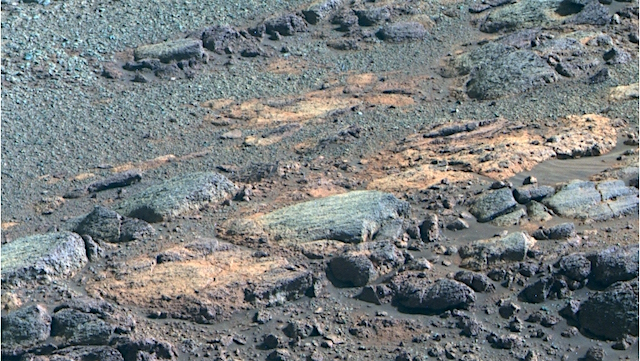
5076-pancamFC1P578895176EFFD2EXP2371L5M1_L2L5L5L7L7Sols 5076-77, May 5-6, 2018. Mission controllers used the rover’s Pancam to shoot five multi-filtered frames to make a false-color composite image of flat-lying tabular rocks at the La Salinera site in Perseverance Valley.

Mission control then drove Opportunity about 10 feet (3 meters) southeast to approach one of the tabular rocks which has been dubbed Inde.

At top is the pre-drive composite, with Inde shown by the arrow. At right is the post-drive view, taken as mission scientists prepare to investigate the rock. False-color Pancam reconstructions are by Holger Isenberg; click either image to enlarge it.

Opportunity raw images, its latest mission status, location map, and atmospheric opacity, known as tau.

Posted in Reports | Tagged , , , , , , , , | Comments Off

Mars is small because giant-planet orbital instabilities choked off its early growth

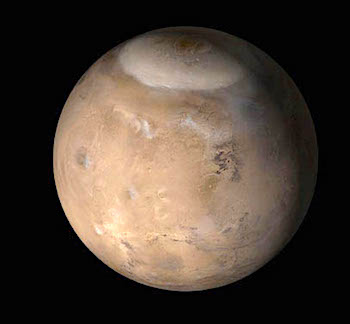
Mars-CropA University of Oklahoma astrophysics team explains why the growth of Mars was stunted by an orbital instability among the outer solar system’s giant planets in a new study on the evolution of the young solar system.

The OU study [published in the journal Icarus] builds on the widely-accepted Nice Model, which invokes a planetary instability to explain many peculiar observed aspects of the outer solar system. An OU model used computer simulations to show how planet accretion (growth) is halted by the outer solar system instability. Without it, Mars possibly could have become a larger, habitable planet like Earth.

“This study offers a simple and more elegant solution for why Mars is small, barren and uninhabitable,” said Matthew S. Clement, OU graduate student in the Homer L. Dodge Department of Physics and Astronomy, OU College of Arts and Sciences. “The particular dynamics of the instability between the giant planets kept Mars from growing to an Earth-mass planet.”

Clement and Nathan A. Kaib, OU astrophysics professor, worked with Sean N. Raymond, the University of Bordeaux, France, and Kevin J. Walsh, Southwest Research Institute, to investigate the effect of the Nice Model instability on the process of terrestrial planetary formation. The research team used computing resources provided by the OU Supercomputing Center for Education and Research and the Blue Waters sustained peta-scale computing project to perform 800 computer simulations of this scenario. [More at links]

Posted in Reports | Tagged , , , , | Comments Off

HiRISE: Pettit Crater wind streak and intracrater dunes

tumblr_p7t8s7noiZ1rlz4gso1_1280Pettit Crater wind streak and intracrater dunes. Part of the rationale for this observation is to look for dune bedforms that may be related to thermal inertia and particle mobility. This crater was named after Edison Pettit, an American astronomer (1890–1962).

Beautiful Mars series. [More at links]

Posted in Reports | Tagged , , , , , , , , , , | Comments Off

InSight’s CubeSats switched on, respond

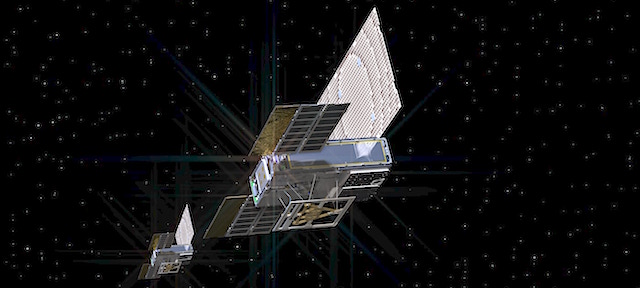
PIA22314-16NASA has received radio signals indicating that the first-ever CubeSats headed to deep space are alive and well. The first signal was received at 12:15 p.m. PST (3:15 p.m. EST) today; the second at 1:58 p.m. PST (4:58 p.m. EST). Engineers will now be performing a series of checks before both CubeSats enter their cruise to deep space.

Mars Cube One, or MarCO, is a pair of briefcase-sized spacecraft that launched along with NASA’s InSight Mars lander at 4:05 a.m. PDT (7:05 a.m. EDT) today from Vandenberg Air Force Base in Central California. InSight is a scientific mission that will probe the Red Planet’s deep interior for the first time; the name stands for Interior Exploration using Seismic Investigations, Geodesy and Heat Transport.

The twin MarCO CubeSats are on their own separate mission: rather than collecting science, they will follow the InSight lander on its cruise to Mars, testing out miniature spacecraft technology along the way.

Both were programmed to unfold their solar panels soon after launch, followed by several opportunities to radio back their health.

“Both MarCO-A and B say ‘Polo!’ It’s a sign that the little sats are alive and well,” said Andy Klesh, chief engineer for the MarCO mission at NASA’s Jet Propulsion Laboratory in Pasadena, California, which built the twin spacecraft.

• InSight mission Twitter feed here. [More at links]

Posted in Reports | Tagged , , , , , , , | Comments Off

THEMIS: Blast zone at Lonar Crater

Blast zone around Lonar Crater (THEMIS_IOTD_20180507)THEMIS Image of the Day, May 7, 2018. This VIS image shows the part of the crater rim and ejecta surrounding Lonar Crater in the northern plains of Vastitas Borealis. There is a fine scale, radial grooved outer layer of ejecta covered by lobate ejecta nearer the crater rim. The ends of the lobes are taller than the material just inside the end of the lobe. Often called rampart ejecta, this morphology can be caused by impact into a surface that includes volatiles such as sub-surface water or ice.

More THEMIS Images of the Day by geological topic.

Posted in Reports | Tagged , , , , , , , , , , , , , | Comments Off

InSight: On its way —

insight-4-768x432Booster ignition and liftoff of the United Launch Alliance Atlas V rocket at 7:05 a.m. EDT (4:05 a.m. PDT), from Space Launch Complex 3 at Vandenberg Air Force Base in California, carrying NASA’s InSight spacecraft. The rocket is on its way, carrying NASA’s Interior Exploration using Seismic Investigations, Geodesy and Heat Transport (InSight) to begin its six-month voyage to Mars.

• InSight mission Twitter feed here. [More at links]

Posted in Reports | Tagged , , , , , , | Comments Off

Opportunity report, Sol 5072, by A.J.S. Rayl, The Planetary Society

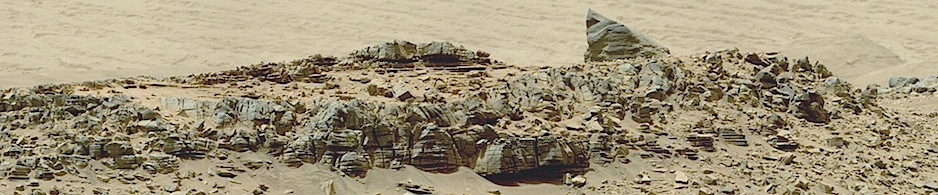
20180504_8-Tabular-rocks-ahead-Sol5058-041618-PC-falseMay 4, 2018: Opportunity Studies Mystery Rock, Mission Officials Seek 2019 Extension: Opportunity spent April further exploring the area about halfway down Perseverance Valley, checking out unusual, vesicular or pitted rocks the likes of which she has never seen, while Mars Exploration Rover (MER) officials prepared the mission’s bid to keep the robot field geologist roving through 2019.

From Endeavour Crater’s west rim, the valley extends downslope, at about a 15-degree angle, for about 200 meters (about 219 yards) ending at the crater interior. Opportunity drove into the valley, which is within the Cape Byron segment, last July to study it and search for signs of anything in the morphology or shape of this place that can reveal what created it billions of years ago.

Although scientists exploring Mars never really know what to expect, as Opportunity hunkered down over one of the charcoal gray vesicular rocks at a site called San Juan Pueblo, they certainly didn’t expect what they found. At least most of them didn’t. And they’re not exactly sure what is means.

“Yes, this is new,” said MER Project Scientist Matt Golombek, of the Jet Propulsion Laboratory (JPL), home to all NASA’s Mars rovers. “It’s a very interesting rock,very unusual. We haven’t seen anything like this before.”

The vesicular rock outcrop that Opportunity looked at up close – and which the scientists thought could be a volcanic basalt rock – turned out to not be a volcanic basaltic rock. And they’re not exactly sure what it is. Hypotheses are being debated, new data is coming in, and analyses are ongoing. Just like Perseverance, the only geologic formation of its kind in the rim segments of Endeavour, this rock is a mystery.

This valley drew the scientists at first sight. In orbital images, Perseverance looks like a river system on Earth, complete with branches leading in different directions. As appealing as water on Mars is though, the MER science team from the outset has been pursuing multiple working hypotheses in its quest to determine its origin. (…)

The plan for 2019 is to keep roving along the tenth mission extension route, which will take Opportunity down to the interior of the crater, to the benches nearby, and, grim-budget-reaper willing, back out of the crater farther to the south. “We want to complete that plan,” said Callas. “We are privileged NASA officials are talking about giving us another year of funding.” [Much more at link]
Posted in Reports | Tagged , , , , , , | Comments Off