THEMIS: Echus Chasma mega-gullies

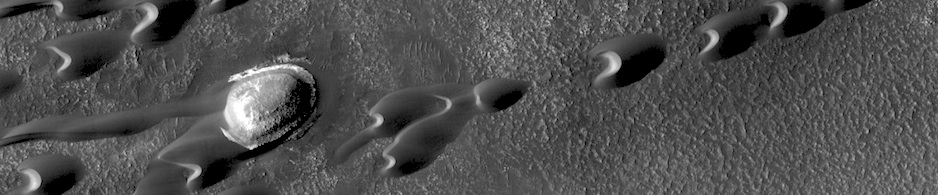
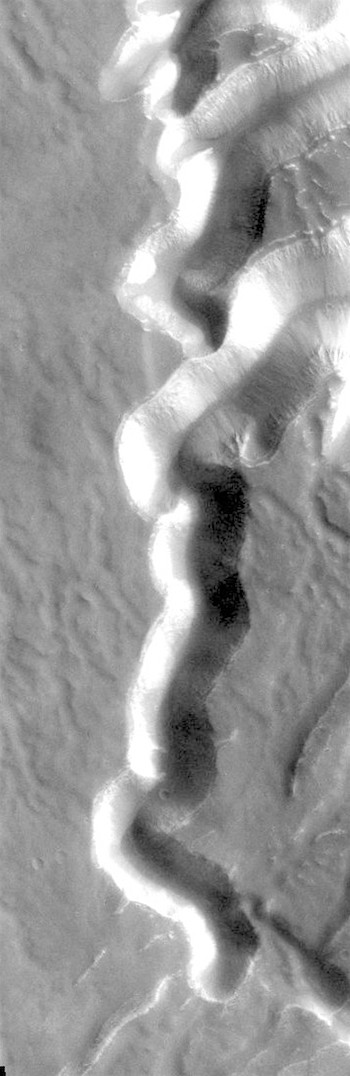
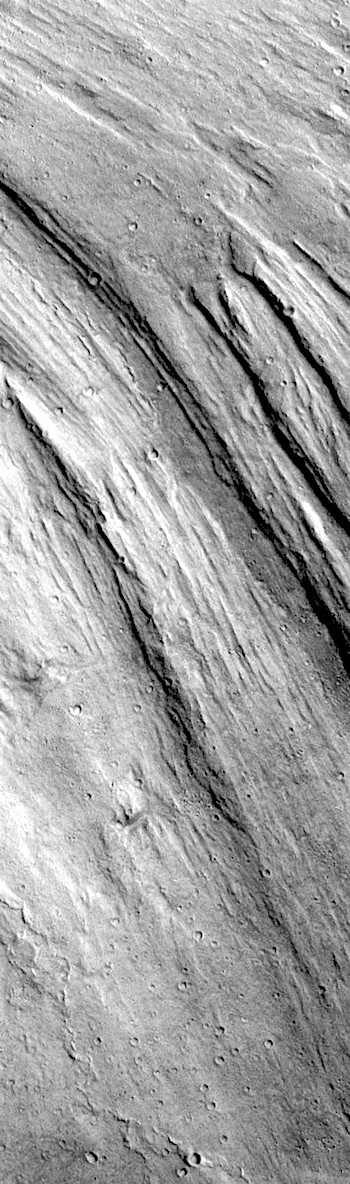
Echus Chasma source of Kasei Valles (THEMIS_IOTD_20180423)THEMIS Image of the Day, April 23, 2018. This VIS image shows one of the mega-gullies that empties into Echus Chasma. Echus Chasma is approximately 4km deep in this region, and is the source of Kasei Valles.

More THEMIS Images of the Day by geological topic.

Posted in Reports | Tagged , , , , , , , , , , , | Comments Off

Opportunity: Crushed rock in false color

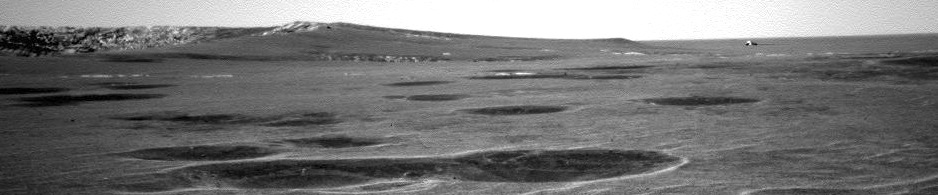
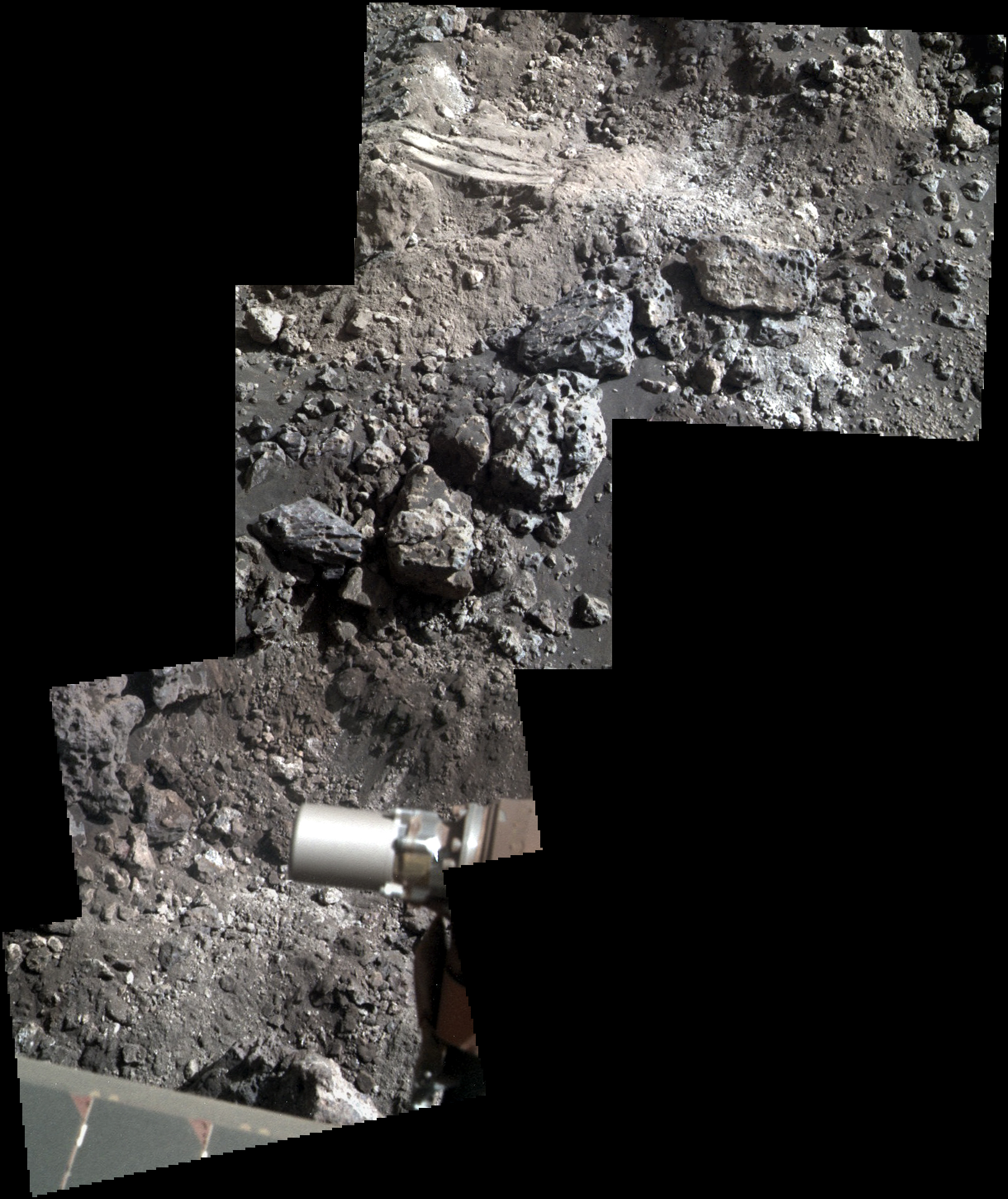
5061-pancamFCSol 5061, April 20, 2018. Mission scientists commanded the Pancam to shoot a series of filtered images along the line of vesicular rocks, part of which was crushed under Opportunity’s wheels in the last few sols. Click the image (false-color reconstructions by Holger Isenberg) to enlarge it.

Opportunity raw images, its latest mission status, location map, and atmospheric opacity, known as tau.

Posted in Reports | Tagged , , , , , , , , | Comments Off

HiRISE: Layers and flow features in Protonilus Mensae

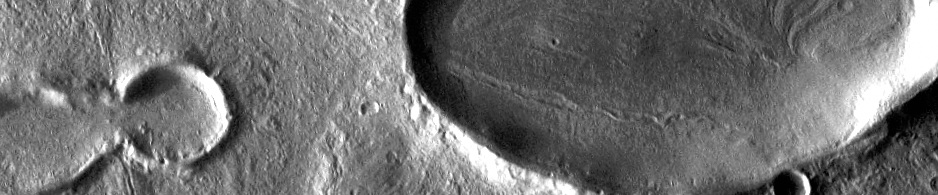
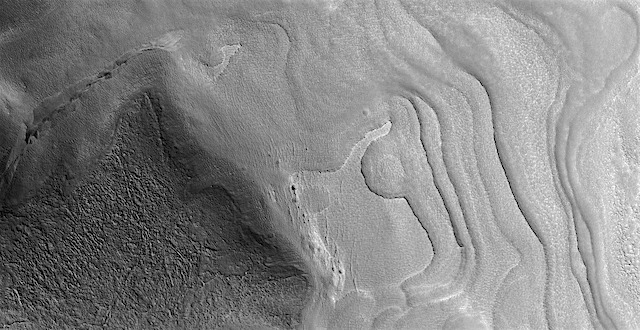
tumblr_p732ecX42Z1rlz4gso1_1280Layers and flow features in Protonilus Mensae. Repeat image to look for glacial and periglacial changes. There are also some interesting superposition of glacial, polygon, gully, fan, and crevasse features. Who wants to take a hike?

Beautiful Mars series. [More at links]

Posted in Reports | Tagged , , , , , , , , , | Comments Off

Curiosity update: A change of season

NRB_577451535EDR_F0692456NCAM00289M_-br2Sols 2027-28, April 20, 2018, update by MSL scientist Scott Guzewich: This was a week of transition for Curiosity’s environmental science team. The cloudy season on Mars has ended as we’ve seen a marked decrease in water ice cloud activity in our Navcam sky movies over the last several weeks and we’re moving quickly into the dusty season on Mars. We will now be drastically reducing the frequency in which we search for clouds and instead focus our attention on dust devils and storms.

The atmosphere is beginning to get dustier, as seen by the hazy look of the northern rim in Gale Crater in this image [above]. Indeed, we began preplanning our annual campaign to study a potential global dust storm, if and when such a storm develops this year. The dusty season on Mars, roughly the second half of the martian year, runs from the end of May until February next year, and we’ll be monitoring closely for the signs that a global dust storm (the last of which occurred way back in 2008!) is developing. [More at link]

Posted in Reports | Tagged , , , , , , , , , , , , | Comments Off

Two CubeSats to go to Mars with InSight

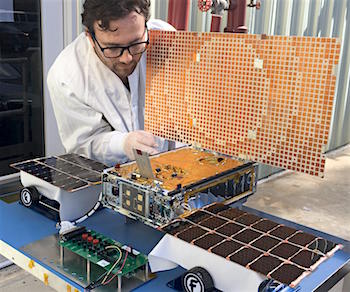
PIA22317Many of NASA’s most iconic spacecraft towered over the engineers who built them: think Voyagers 1 and 2, Cassini or Galileo — all large machines that could measure up to a school bus. But in the past two decades, mini-satellites called CubeSats have made space accessible to a new generation. These briefcase-sized boxes are more focused in their abilities and have a fraction of the mass — and cost — of some past titans of space.

In May, engineers will be watching closely as NASA launches its first pair of CubeSats designed for deep space. The twin spacecraft are called Mars Cube One, or MarCO, and were built at NASA’s Jet Propulsion Laboratory in Pasadena, California.

Both MarCO spacecraft will be hitching a ride on the same rocket launching InSight, NASA’s next robotic lander headed for Mars. The MarCOs are intended to follow InSight on its cruise through space; if they survive the journey, each is equipped with a folding high-gain antenna to relay data about InSight as it enters the Martian atmosphere and lands.

The MarCOs won’t produce any science of their own, and aren’t required for InSight to send its data back home (the lander will rely on NASA’s Mars orbiters for that, in addition to communicating directly with antennas on Earth). But the twins will be a crucial first test of CubeSat technology beyond Earth orbit, demonstrating how they could be used to further explore the solar system.

“These are our scouts,” said Andy Klesh of JPL, MarCO’s chief engineer. “CubeSats haven’t had to survive the intense radiation of a trip to deep space before, or use propulsion to point their way towards Mars. We hope to blaze that trail.” [More at link]
Posted in Reports | Tagged , , , , , , | Comments Off

Mud cracks help reveal the shape of water on Mars

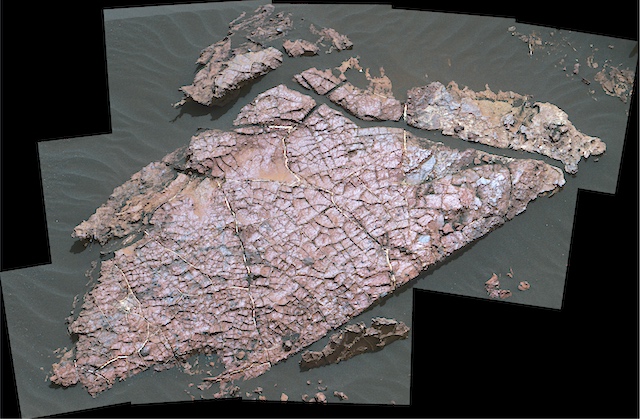
1814-OldSoakerAs Curiosity rover marches across Mars, the red planet’s watery past comes into clearer focus. In early 2017 scientists announced the discovery of possible desiccation cracks in Gale Crater, which was filled by lakes 3.5 billion years ago. Now, a new study has confirmed that these features are indeed desiccation cracks, and reveals fresh details about Mars’ ancient climate.

“We are now confident that these are mudcracks,” explains lead author Nathaniel Stein, a geologist at the California Institute of Technology in Pasadena. Since desiccation mudcracks form only where wet sediment is exposed to air, their position closer to the center of the ancient lake bed rather than the edge also suggests that lake levels rose and fell dramatically over time.

“The mudcracks show that the lakes in Gale Crater had gone through the same type of cycles that we see on Earth,” says Stein. The study was published in Geology online ahead of print on 16 April 2018.

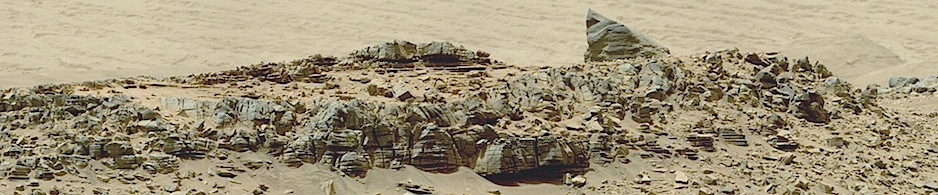
The researchers focused on a coffee table-sized slab of rock nicknamed “Old Soaker.” Old Soaker is crisscrossed with polygons identical in appearance to desiccation features on Earth. The team took a close physical and chemical look at those polygons using Curiosity’s Mastcam, Mars Hand Lens Imager, ChemCam Laser Induced Breakdown Spectrometer (LIBS), and Alpha-Particle X-Ray Spectrometer (APXS). [More at links]

Posted in Reports | Tagged , , , , , , , , , , , , , | Comments Off

HiRISE: Chaos terrain

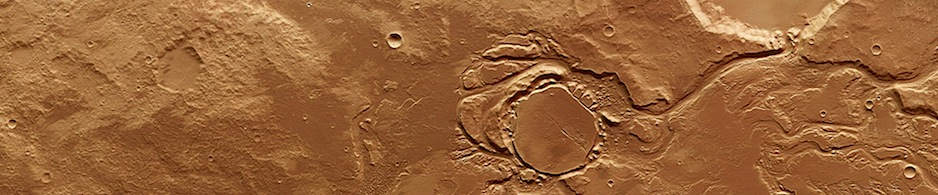
ESP_054635_1800This image shows chaos terrain on Mars’ equator.

NB: HiRISE has not been allowed to acquire off-nadir targeted observations for a couple of months due to MRO spacecraft issues, so many high-priority science objectives are on hold. What can be usefully accomplished in nadir mode is sampling of various terrains. Especially interesting are bedrock exposures, which provide information about the geologic history of Mars. [More at link]

Posted in Reports | Tagged , , , , , , , | Comments Off

THEMIS: Flood-scoured floor of Lobo Vallis

Flood-channel floor in Lobo Vallis (THEMIS_IOTD_20180420)THEMIS Image of the Day, April 20, 2018. Today’s VIS image shows a small portion of Lobo Vallis near where it recombines with Kasei Valles and empties into Chryse Planitia. Kasei Valles is a huge channel system that drained the higher elevations of Tharsis into the low of Chryse Planitia.

More THEMIS Images of the Day by geological topic.

Posted in Reports | Tagged , , , , , , , , , , , | Comments Off

HiRISE: Diverse lithologies on a crater floor

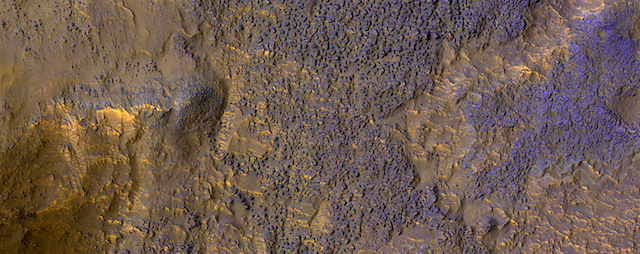
ESP_054682_1685This image shows bedrock units with diverse colors indicating different mineral concentrations.

NB: HiRISE has not been allowed to acquire off-nadir targeted observations for a couple of months due to MRO spacecraft issues, so many high-priority science objectives are on hold. What can be usefully accomplished in nadir mode is sampling of various terrains. Especially interesting are bedrock exposures, which provide information about the geologic history of Mars. [More at link]

Posted in Reports | Tagged , , , , , | Comments Off

MARCI weather report, April 9-15, 2018

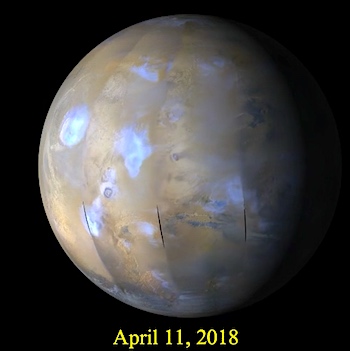
MARCI-April-11-2018Dust storm activity continued along the seasonal south polar ice cap edge of Mars this past week. Equatorward of the southern seasonal cap edge, local-scale dust storms were observed over Noachis and Cimmeria. At the beginning of the week, a short-lived dust storm was spotted over northwestern Hellas. The northern lowlands were partial obscured by scattered dust and water-ice clouds. Dust clouds, largely from the previous week’s activity continued to spread and abate over Acidalia Planitia. Looking to the tropics and extratropics, dust-lifting activity was sparse apart from some activity over Sinus Sabaeus and Syrtis at the end of the week. Each afternoon… [More at link, including video]

Posted in Reports | Tagged , , , , , , , , , , , , , | Comments Off