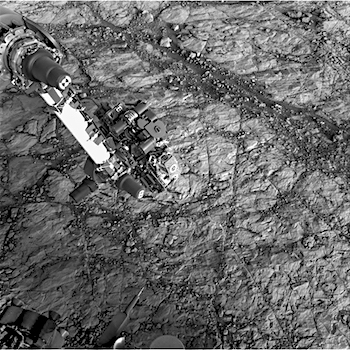
Opportunity: Closeup on Mesilla rock texture

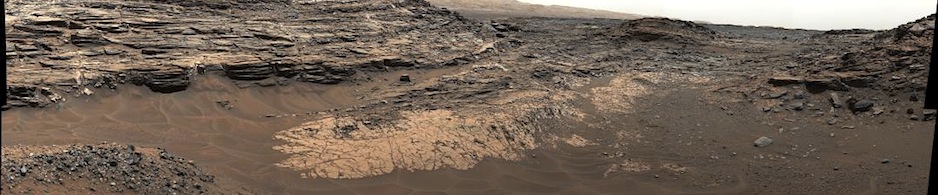
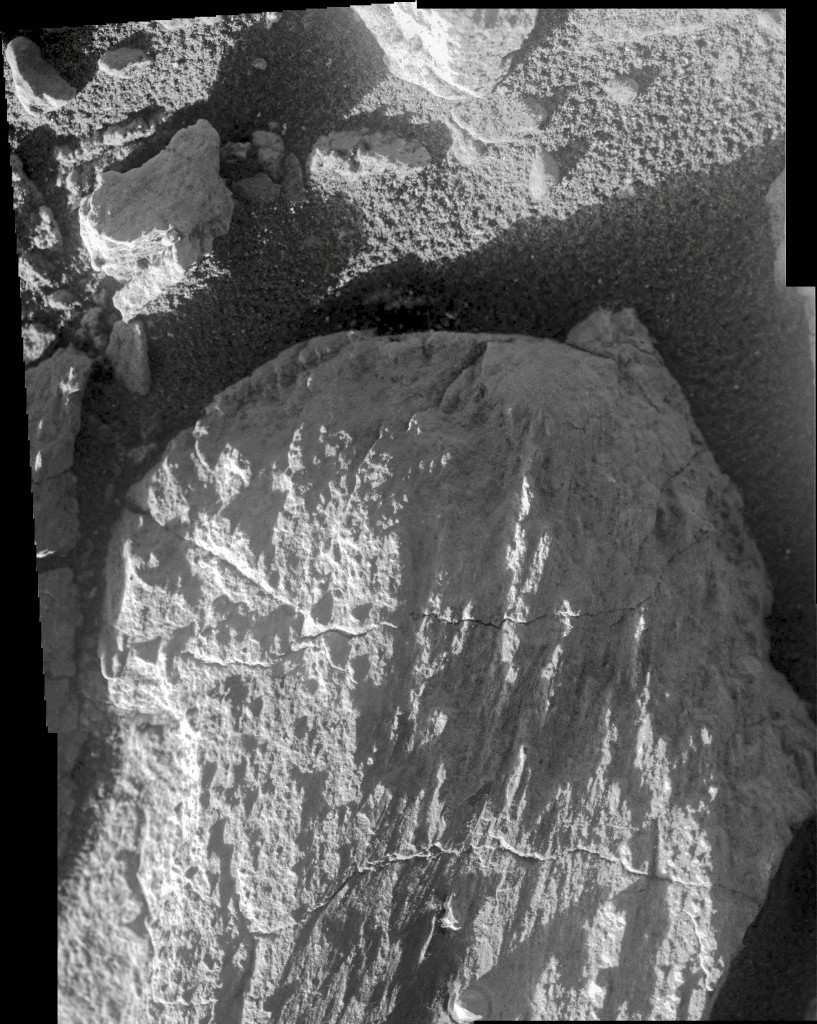
4895-MI-Mesilla-817x1024Sol 4895, October 31, 2017. Rover scientists commanded the Microscopic Imager to shoot six frames on a grooved rock dubbed Mesilla at the La Bajada site, as they seek to find out what made the grooves. Wind? Water? Unclear as yet. Click image to enlarge it.

Opportunity raw images, its latest mission status, location map, and atmospheric opacity, known as tau.

Posted in Reports | Tagged , , , , , , , , | Comments Off

Next Mars rover will have 23 eyes

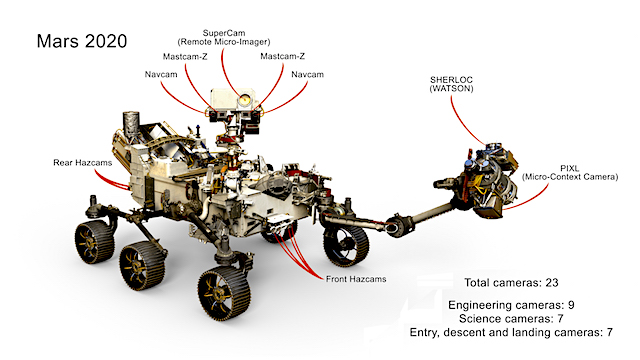
PIA22103_hiresWhen NASA’s Mars Pathfinder touched down in 1997, it had five cameras: two on a mast that popped up from the lander, and three on NASA’s first rover, Sojourner.

Since then, camera technology has taken a quantum leap. Photo sensors that were improved by the space program have become commercially ubiquitous. Cameras have shrunk in size, increased in quality and are now carried in every cellphone and laptop.

That same evolution has returned to space. NASA’s Mars 2020 mission will have more “eyes” than any rover before it: a grand total of 23, to create sweeping panoramas, reveal obstacles, study the atmosphere, and assist science instruments. They will provide dramatic views during the rover’s descent to Mars and be the first to capture images of a parachute as it opens on another planet. There will even be a camera inside the rover’s body, which will study samples as they’re stored and left on the surface for collection by a future mission.  [More at link]

Posted in Reports | Tagged , , | Comments Off

THEMIS: Collapse pits and lava tubes

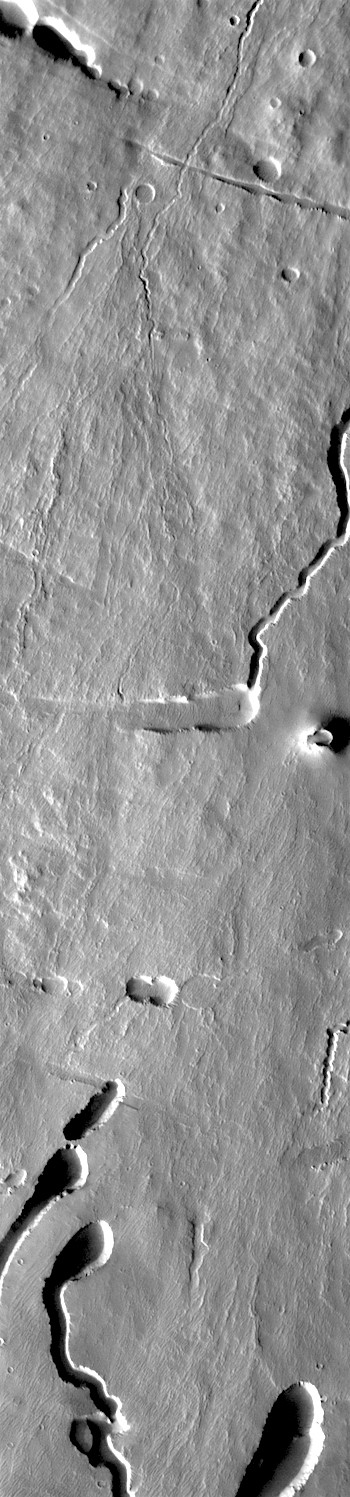
Lava tubes and flows on Pavonis Mons (THEMIS_IOTD_20171101)THEMIS Image of the Day, November 1, 2017. This image shows part of the southern flank of Pavonis Mons. Several faults run from the left to the right side of the image. Lava flows, and the lava collapse features at the bottom of the image are aligned with the down hill direction (in this case from the top of the image to the bottom). Near the top of the image there are collapse features that run along the faults. The fault may have been been a location for lava tube development.

Pavonis Mons is one of the three aligned Tharsis Volcanoes. The four Tharsis volcanoes are Ascreaus Mons, Pavonis Mons, Arsia Mons, and Olympus Mars. All four are shield type volcanoes. Shield volcanoes are formed by lava flows originating near or at the summit, building up layers upon layers of lava. The Hawaiian islands on Earth are shield volcanoes. The three aligned volcanoes are located along a topographic rise in the Tharsis region. Along this trend there are increased tectonic features and additional lava flows.

Pavonis Mons is the smallest of the four volcanoes, rising 14 km above the mean Mars surface level with a width of 375 km. It has a complex summit caldera, with the smallest caldera deeper than the larger caldera. Like most shield volcanoes the surface has a low profile. In the case of Pavonis Mons the average slope is only 4 degrees.

NASA’s Mars Odyssey spacecraft has spent over 15 years in orbit around Mars, circling the planet more than 69,000 times. It holds the record for longest working spacecraft at Mars. THEMIS, the IR/VIS camera system, has collected data for the entire mission and provides images covering all seasons and lighting conditions.

Over the years many features of interest have received repeated imaging, building up a suite of images covering the entire feature. From the deepest chasma to the tallest volcano, individual dunes inside craters and dune fields that encircle the north pole, channels carved by water and lava, and a variety of other feature, THEMIS has imaged them all.

For the next several months the Image of the Day will focus on the Tharsis volcanoes, the various chasmata of Valles Marineris, and the major dunes fields. We hope you enjoy these images!

More THEMIS Images of the Day by geological topic.
Posted in Reports | Tagged , , , , , , , , , , , , | Comments Off

Curiosity: Standing by

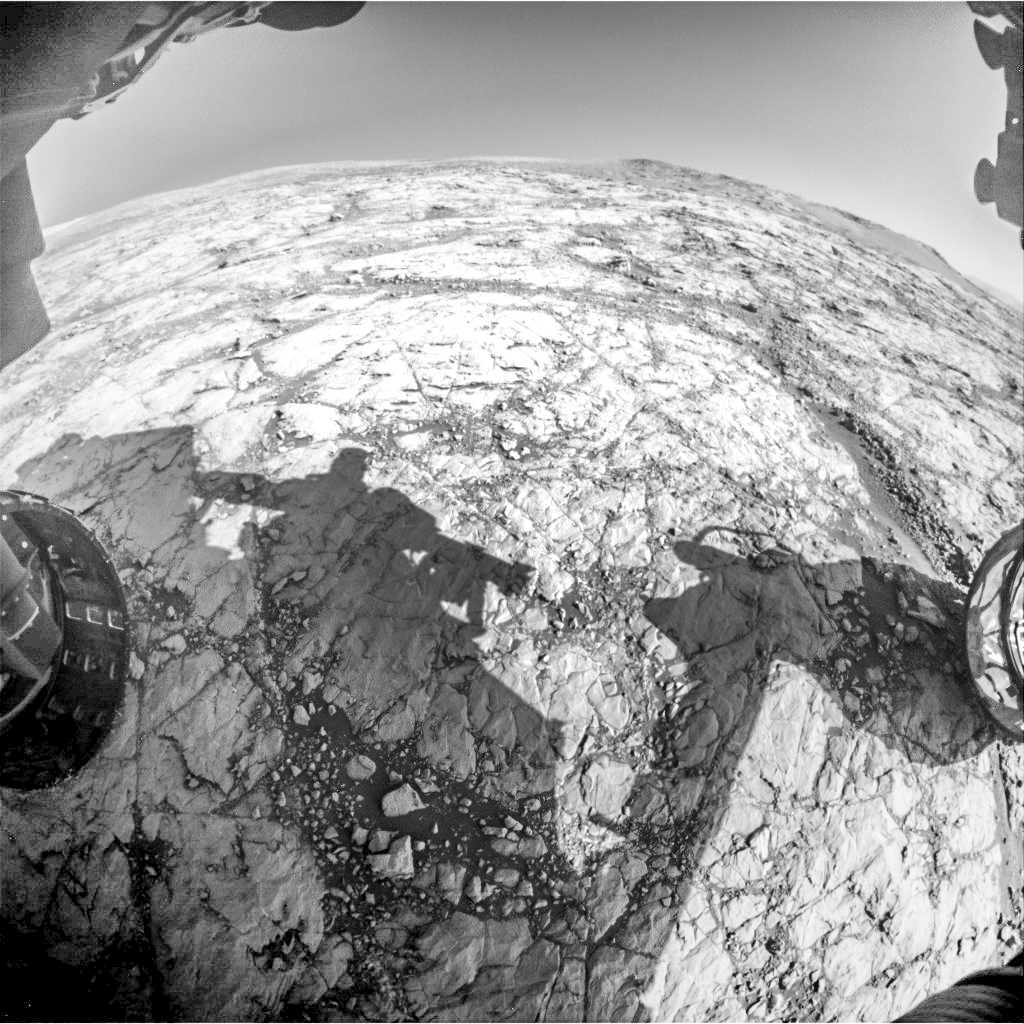
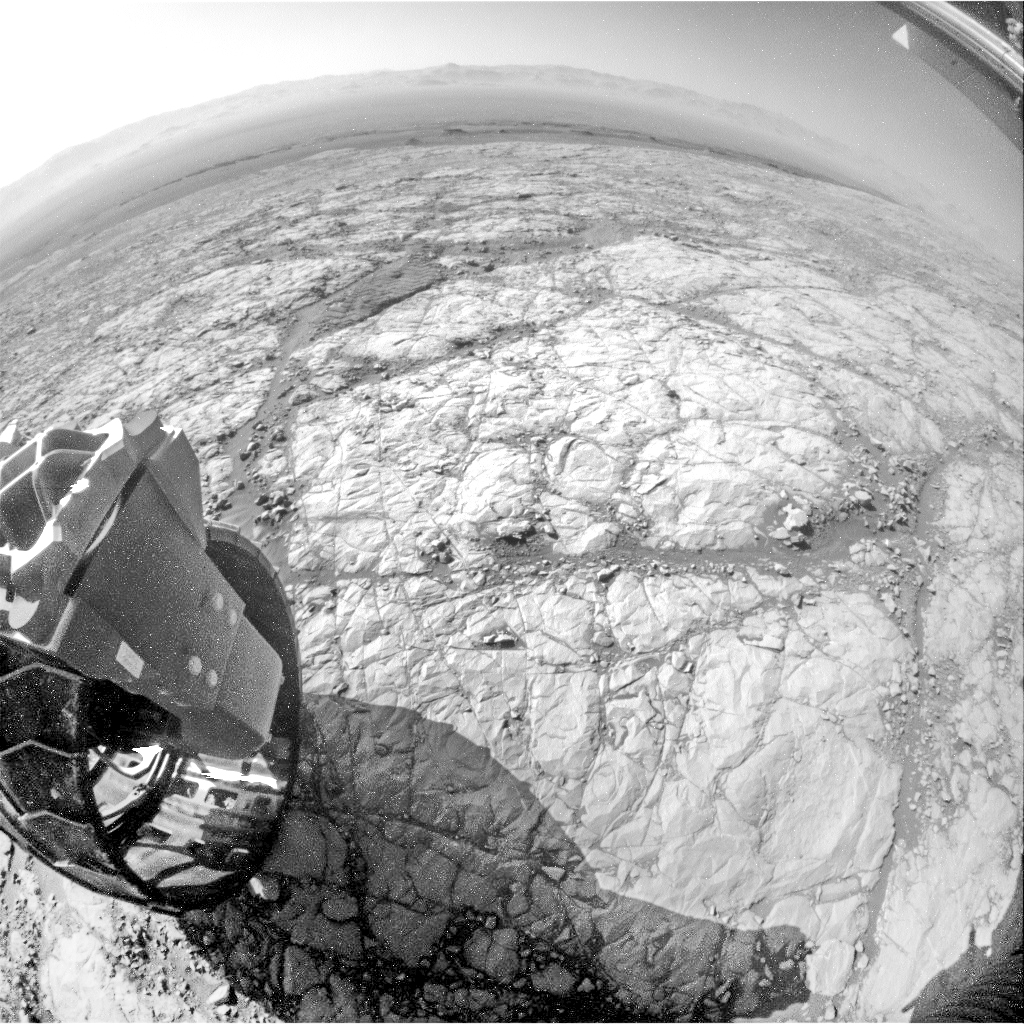
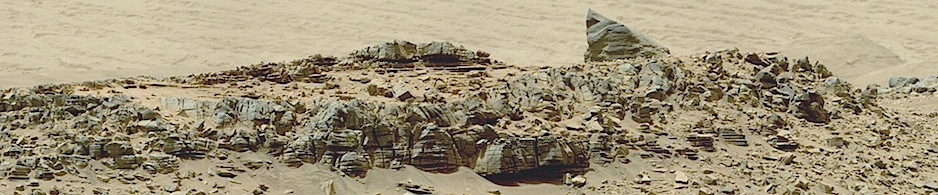
FLB_562710990EDR_F0661804FHAZ00341M_Sol 1861, October 31, 2017. Curiosity’s left Hazcams, front and rear, look out on the fractured rock atop Vera Rubin Ridge, where the rover is currently parked. Mission engineers and scientists are working through stubborn issues to do with the instrument arm. The local time for these images was about 2:30 p.m. Click either image to enlarge it.

RLB_562711024EDR_F0661804RHAZ00341M_Sol 1861 raw images (from all cameras), and Curiosity’s latest location.

Posted in Reports | Tagged , , , , , , , , | Comments Off

Are small martian landslides similar to large ones on Earth?

chryse-chaos-slidePlanetary Geomorphology Image of the Month, October 31, 2017: Susan Conway and Anthony Guimpier (CNRS Laboratoire de Planétologie et Géodynamique à Nantes, France). Landslides have been documented on almost all the solid bodies of the solar system and Mars is no exception. The most famous landslides on Mars are the giant landslides in the Valles Marineris, which were discovered in the images returned by the first Mars Orbiter “Mariner 9” launched in 1971 (Lucchitta, 1979). They have volumes typically ranging from 108-1013 m3 (McEwen 1989; Quentin et al. 2004; Brunetti et al. 2014) and have been found to have occurred periodically since the canyon’s formation 3.5 billion years ago (Quantin et al. 2004). The largest size of terrestrial landslides generally only extends to 108 m3 (McEwen 1989; Quentin et al. 2004).

Image 1 shows 3D views of two landslides on Mars imaged by NASA’s Mars Reconnaissance Orbiter HiRISE camera. Their topography has been reconstructed using stereophotogrammetry – using the difference in two images taken from different angles to build a digital elevation model – a tool available for free from NASA called the Ames Stereo Pipeline. These are relatively small landslides for Mars with volumes less than 108 m3. A landslide with similar dimensions and volume on Earth is the Frank Slide in Alberta, Canada (Image 2). However, there are some interesting differences…. [More at link]

Posted in Reports | Tagged , , , | Comments Off

Curiosity update: The curse of Vera Rubin Ridge strikes again

NRB_562613983EDR_M0661804NCAM00567M_-br2Sols 1861-61, October 30, 2017, update by MSL scientist Ryan Anderson: We are starting to suspect that Vera Rubin Ridge might be cursed. After the challenges we faced last week, we were hoping for a successful weekend plan but alas, it was not to be. Over the weekend Curiosity’s arm didn’t heat up as much as it was supposed to, so the arm activity failed and most of the weekend plan was lost. So today the name of the game is to try again!

The main activity in the 1861-1862 plan is another attempt at dropping off the “Ogunquit Beach” sample in the SAM instrument, followed by SAM Evolved Gas Analysis (EGA) of the sample. In other words, SAM will heat the sample and measure what gases are produced. On sol 1862 there will be a science block where we will try to recover some of the remote sensing that was planned for the weekend. This will begin with a Mastcam mosaic that builds upon some previous Mastcam images of “Region 7″, followed by ChemCam and Mastcam observations of the bedrock targets “Schmidtsdrif” and “Estecourt” as well as the soil target “Lisbon”. The science block will end the way it began, with another Mastcam mosaic… [More at link]

Posted in Reports | Tagged , , , , , , , , , , , , , | Comments Off

THEMIS: Fractures on Pavonis Mons’ flank

Faults on the flank of Pavonis Mons (THEMIS_IOTD_20171031)THEMIS Image of the Day, October 31, 2017. This image shows part of the western flank of Pavonis Mons. The linear features are faults. Faulting usually includes change of elevation, where blocks of material slide down the fault. Paired faults are call graben. The large depression is a graben, whereas most of the other faults are not paired. The rougher looking materials perpendicular to the faults are lava flows. “Downhill” is toward the upper left corner of the image.

Pavonis Mons is one of the three aligned Tharsis Volcanoes. The four Tharsis volcanoes are Ascreaus Mons, Pavonis Mons, Arsia Mons, and Olympus Mars. All four are shield type volcanoes. Shield volcanoes are formed by lava flows originating near or at the summit, building up layers upon layers of lava. The Hawaiian islands on Earth are shield volcanoes. The three aligned volcanoes are located along a topographic rise in the Tharsis region. Along this trend there are increased tectonic features and additional lava flows.

Pavonis Mons is the smallest of the four volcanoes, rising 14 km above the mean Mars surface level with a width of 375 km. It has a complex summit caldera, with the smallest caldera deeper than the larger caldera. Like most shield volcanoes the surface has a low profile. In the case of Pavonis Mons the average slope is only 4 degrees.

NASA’s Mars Odyssey spacecraft has spent over 15 years in orbit around Mars, circling the planet more than 69,000 times. It holds the record for longest working spacecraft at Mars. THEMIS, the IR/VIS camera system, has collected data for the entire mission and provides images covering all seasons and lighting conditions.

Over the years many features of interest have received repeated imaging, building up a suite of images covering the entire feature. From the deepest chasma to the tallest volcano, individual dunes inside craters and dune fields that encircle the north pole, channels carved by water and lava, and a variety of other feature, THEMIS has imaged them all.

For the next several months the Image of the Day will focus on the Tharsis volcanoes, the various chasmata of Valles Marineris, and the major dunes fields. We hope you enjoy these images!

More THEMIS Images of the Day by geological topic.

Posted in Reports | Tagged , , , , , , , , , , , , , , , , | Comments Off

Opportunity: Shadows of afternoon lengthen

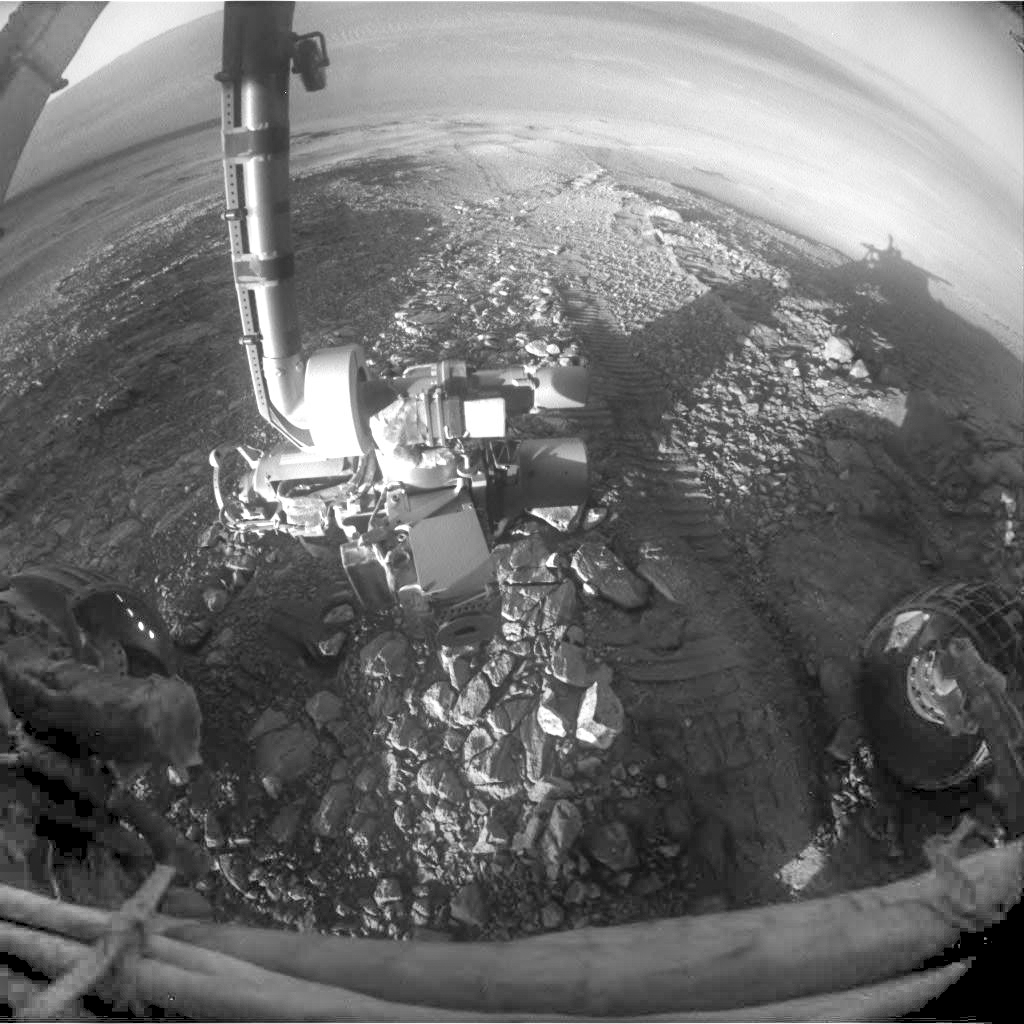
1F562575352EFFD0EOP1231L0M1Sol 4893, October 29, 2017. Opportunity is parked in the area dubbed La Bajada. The top shot at right was taken by the left Hazcam at 3:38 p.m. local time, the one below 19 minutes later. Click either to enlarge it.

1F562576528EFFD0EOP1211L0M1Opportunity raw images, its latest mission status, location map, and atmospheric opacity, known as tau.

Posted in Reports | Tagged , , , , , , , | Comments Off

HiRISE: Channels (and dunes) in Libya Montes

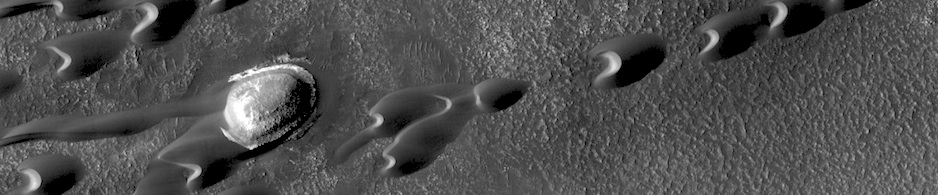
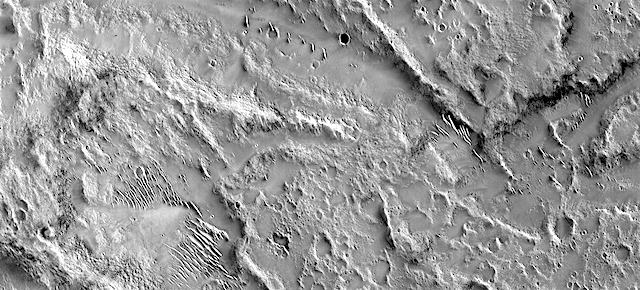
tumblr_oynbclpysy1rlz4gso1_1280Channels, channels, who’s got the channels? Beautiful Mars series.

Posted in Reports | Tagged , , , , , , , , , , | Comments Off

Curiosity update: A working weekend

NRB_561920678EDR_F0661804NCAM00207M_-br2Sols 1858-60, October 27, 2017, update by MSL scientist Mark Salvatore: Following a series of setbacks this week, Curiosity is on track to have a productive, albeit stationary, weekend. Monday’s communication issue and Wednesday’s possible difficulties in delivering the “Ogunquit Beach” sample to the Sample Analysis at Mars (SAM) instrument have given the science team a series of headaches as we try to make progress along Vera Rubin Ridge. Even yesterday, the team discovered an error with the left Mastcam data transfer that has marked the instrument temporarily SICK and is preventing us from acquiring new data from it until sometime after this weekend’s plan. Nonetheless, the team is optimistic moving into the weekend, and has planned a really nice suite of observations.

Curiosity will try one more time to deliver Ogunquit Beach sample to the SAM instrument, and SAM will hopefully perform an evolved gas analysis (EGA) on the sample overnight on the first evening of this weekend’s plan. Curiosity will spend the majority of the following day (Saturday) sleeping and recharging, as the EGA analyses require significant power to perform. Towards the end of that day, Curiosity will image and brush a patch of flat bedrock in front of the rover named “Sibasa” and will analyze this patch of bedrock with the Alpha Particle X-Ray Spectrometer (APXS) instrument to accurately characterize the chemistry of this region. This will be an overnight measurement… [More at link]

Posted in Reports | Tagged , , , , , , , , , , , , , | Comments Off